
Gandhi’s 1922 Trial And The Changing Meaning Of Dissent
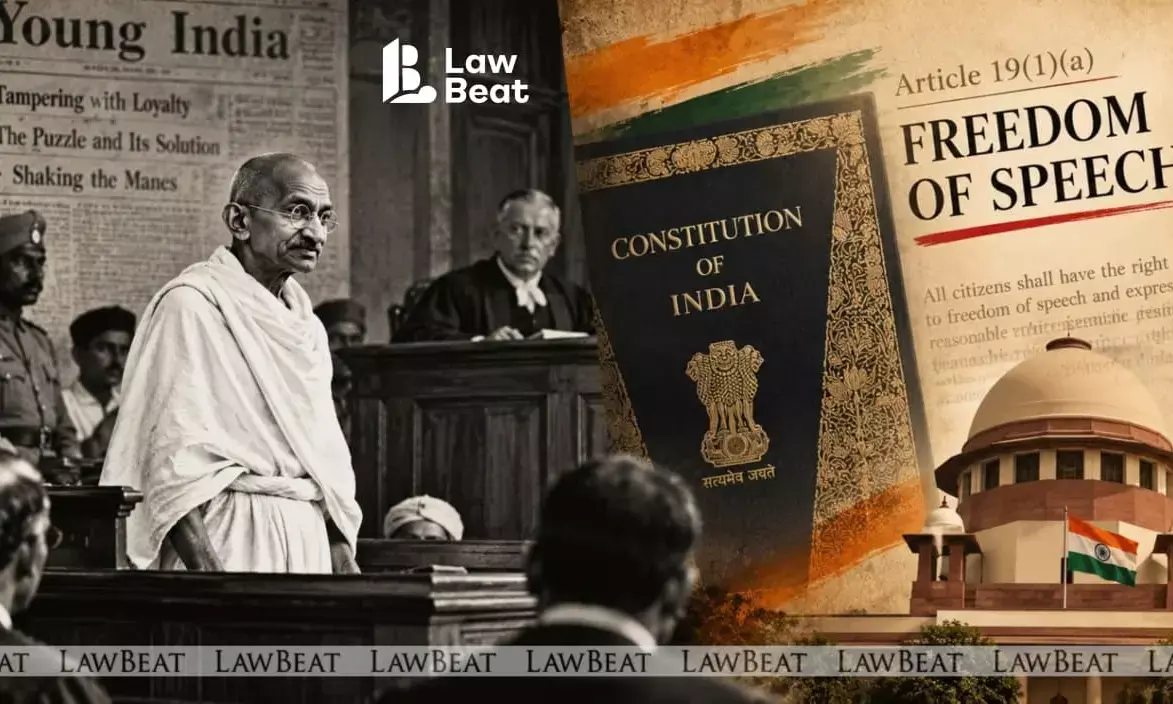
Mahatma Gandhi during his 1922 sedition trial in Ahmedabad, which remains relevant to debates on dissent and free speech.
On March 18, 1922, Mahatma Gandhi stood trial in Ahmedabad on a charge of sedition. He appeared without counsel, pleaded guilty and, instead of seeking leniency, asked the court to impose the maximum sentence.
Gandhi was prosecuted under Section 124A of the Indian Penal Code for three articles published in Young India: “Tampering with Loyalty”, “The Puzzle and Its Solution” and “Shaking the Manes”. He was charged with bringing, or attempting to bring, hatred or contempt, or exciting or attempting to excite disaffection towards the government established by law in British India.
He was sentenced to six years.
More than a century later, the trial remains relevant not simply as an episode in the freedom movement, but because the law governing dissent has changed considerably since Gandhi stood in that courtroom, even as questions about the limits of protest and criticism remain.
Senior Advocate Geeta Luthra describes the Ahmedabad trial as “a striking reminder of how the law of sedition was once used by the colonial State against political dissent".
But the legal position today is materially different.
Section 124A of the IPC, the provision under which Gandhi was prosecuted, has been repealed with effect from July 1, 2024. The Bharatiya Nyaya Sanhita, 2023 does not use the word “sedition”. Instead, Section 152 creates an offence titled “Acts endangering sovereignty, unity and integrity of India”.
As Luthra points out, Section 152 covers purposely or knowingly exciting or attempting to excite secession, armed rebellion or subversive activities, encouraging separatist activities, or acts endangering the sovereignty or unity and integrity of India. At the same time, it expressly preserves comments expressing disapprobation of governmental measures or administrative action when seeking their alteration through lawful means, provided they do not excite or attempt to excite the prohibited activities.
That distinction is significant when viewed against Gandhi's trial.
From sedition to Section 152
Gandhi's prosecution centred on “disaffection” towards the government established by law. The present provision is framed around threats to the sovereignty, unity and integrity of India and specified forms of conduct.
Luthra points out that “the government of the day is always different from the state that is the country/nation”. Referring to the Supreme Court's decision in Kedarnath, she says that “under the law of sedition, clothed under a new definition government and state should not be equated”.
“If this is kept in mind, then much dissent cannot be treated as being an offence under the new law under section 152,” she adds.
The constitutional framework also starts from a different position from the colonial setting in which Gandhi was prosecuted.
Articles 19(1)(a) and 19(1)(b) guarantee freedom of speech and expression and the right to assemble peaceably and without arms. These rights are subject to reasonable restrictions, including in the interests of public order and the sovereignty and integrity of India.
Luthra notes that the Supreme Court has expressly recognised legitimate dissent as an important feature of democratic political life.
The distinction, therefore, is not between a government that agrees with a protest and one that does not. It is between expression and conduct that crosses a legally prescribed boundary.
“There is no single ‘protest law’,” Luthra says, pointing instead to the constitutional protection for speech and peaceful assembly alongside statutory restrictions governing the manner in which protests may be conducted.
The BNS, for instance, contains provisions dealing with unlawful assembly and rioting under Sections 189 and 191.
What remains relevant about Gandhi?
Gandhi's conduct during the 1922 trial adds another dimension to the legal history.
He did not deny writing the articles. He pleaded guilty and asked the court to impose the maximum sentence. Luthra says his conduct demonstrated that “dissent need not mean rejection of law itself”. It could instead mean challenging “the morality or justice of a particular law while accepting the consequences of doing so”.
That distinction remains relevant to a constitutional democracy in which citizens can criticise governments, challenge laws and peacefully protest, while remaining subject to restrictions prescribed by law.
For young citizens in particular, Gandhi's trial presents a different idea of dissent from simply opposing authority. His position was that dissent could coexist with an acceptance of the legal consequences of one's actions.
Luthra says, “In a constitutional democracy, citizens have the right to speak, criticise and peacefully assemble, subject to lawful and reasonable restrictions".
At the same time, “governments may disagree with the objectives or substance of a protest, but disagreement with dissent should not, by itself, become a substitute for the legal test".
That legal test matters because the State's disagreement with a particular message is not itself the measure of whether conduct falls within a criminal provision. The statutory ingredients of the offence remain decisive.
A different India, but a continuing question
The transformation from Section 124A to Section 152 is therefore not merely a change in terminology. The legal framework now expressly distinguishes lawful criticism of governmental measures from specified conduct threatening sovereignty, unity and integrity.
Yet the underlying constitutional question remains familiar: how much space should a democracy leave for disagreement?
Luthra invokes John Stuart Mill's words from On Liberty: “If all mankind minus one, were of one opinion, and only one person were of the contrary opinion, mankind would be no more justified in silencing that one person…”
Gandhi's 1922 trial belongs to a very different constitutional and political era. Yet its enduring relevance lies in the fact that it places the idea of dissent before the legal system in its starkest form: a citizen challenging authority, a law defining the limits of that challenge, and a court deciding the legal consequence.
As Luthra puts it, Gandhi's legacy is a reminder that “the strength of a democracy is reflected not only in its ability to govern, but also in its capacity to accommodate criticism, disagreement and peaceful dissent".