
"Investment Law Must Protect Both Investment And Sovereignty": Justice P S Narasimha
Investment Law's Next Test Is Institutions, Not Just Investor Protection: Justice Narasimha
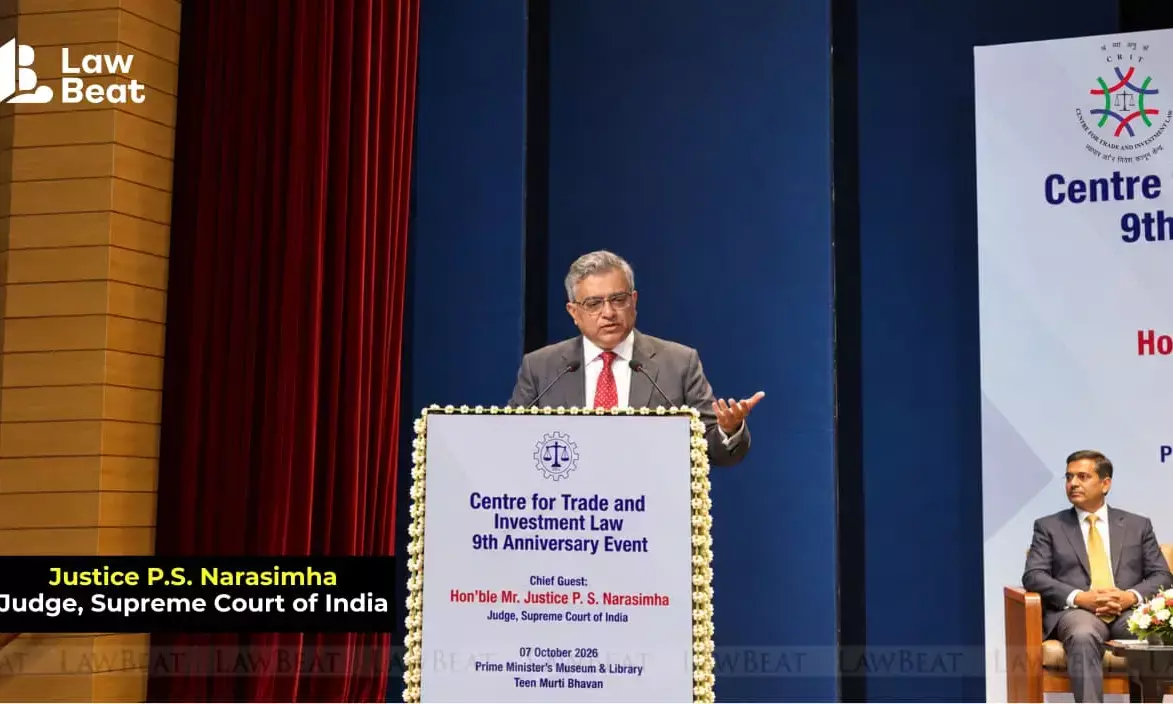
Justice P S Narasimha, Judge, Supreme Court of India on Wednesday said the future of international investment law will depend less on how much protection an investor receives and more on which institutions can be trusted to balance private capital with public power.
Delivering the keynote address at the ninth anniversary of the Centre for Trade and Investment Law (CTIL) in New Delhi, Justice Narasimha said the field is entering a third phase, where questions once thought settled are returning with fresh urgency.
He said the first generation of investment law largely protected foreign investors, while the reaction that followed stressed the regulatory freedom of states. Today, he said, the debate is no longer about how much protection an investor should get or how much freedom a state should keep. The deeper question is who should decide where the balance lies, and what purpose the investment regime is ultimately meant to serve.
Tracing the system's growth, he noted the ICSID Convention allowed investors to take claims directly against states before international tribunals. But as arbitration began touching taxation, public health, the environment and financial regulation, governments asked how a system built to protect investment could also limit their power to govern.
He pointed to tribunal rulings that sided with states, including Uruguay's tobacco regulations, California's ban on the fuel additive MTBE and Canada's pesticide restrictions. "States do not give up the regulatory function of government when they enter into investment treaties," he said.
Yet, he cautioned, recognising the right to regulate does not solve the larger problem. Investment disputes can affect millions of people, but are decided by tribunals set up for a single case, with no general appellate structure. Proceedings are lengthy and expensive, damages can be huge, and questions persist about the independence of arbitrators. Argentina's financial crisis cases, where tribunals reached different conclusions on similar emergency measures, showed the risk of inconsistency.
"The problem therefore is not about what investment treaties say; it is also about institutions that interpret and apply them," he said.
Welcoming UNCITRAL Working Group III's work, including the proposal for a standing mechanism with appellate review, he said institutional design is only part of the answer, because treaties carry different obligations. Reform has too often been episodic, with each controversial award producing a new clause. "We cannot address each weakness in investment law simply by adding another exception to another treaty," he said.
The better question, he said, is "what kind of system we want to have 20 or 30 years from now." Success "cannot simply mean that investors win more cases," nor should it mean making it almost impossible for investors to bring claims. The task is not to choose between investment and sovereignty, but to build a legal order that protects both.
Turning to India, he said the old divide between capital-exporting and capital-importing states is changing. India is now both a destination for foreign investment and the home of companies investing abroad.
He recalled that the White Industries case showed investment law could reach the functioning of domestic institutions. Retrospective taxation disputes, where tribunals ruled against India in the Vodafone and Cairn matters, and the Antrix case involving satellite spectrum and national security, deepened that concern. The 2015 Model BIT then narrowed the definition of investment, dropped the most favoured nation clause and required investors to exhaust domestic remedies.
But reform, he said, cannot swing from one extreme to the other. The India-UAE BIT signed in 2024 departed from the 2015 model, cutting the domestic remedies period from five years to three.
There is no single Global South model, he said, pointing to Brazil, South Africa and the African Union's AfCFTA investment protocol. "Countries that were more largely rule takers are increasingly becoming rule makers," he observed.
Urging institutions like CTIL to help design the next generation of rules, he concluded with Sri Aurobindo's vision of "a free association of free nations."
Event Name: Centre for Trade and Investment Law 9th Anniversary
Event Date: October 7, 2026