
Judges Need Technology And Society Needs To Know How Hard They Work: Justice Prathiba M. Singh
India Needs Uniform IP Courts Across the Country, Says Delhi High Court Judge Prathiba M. Singh
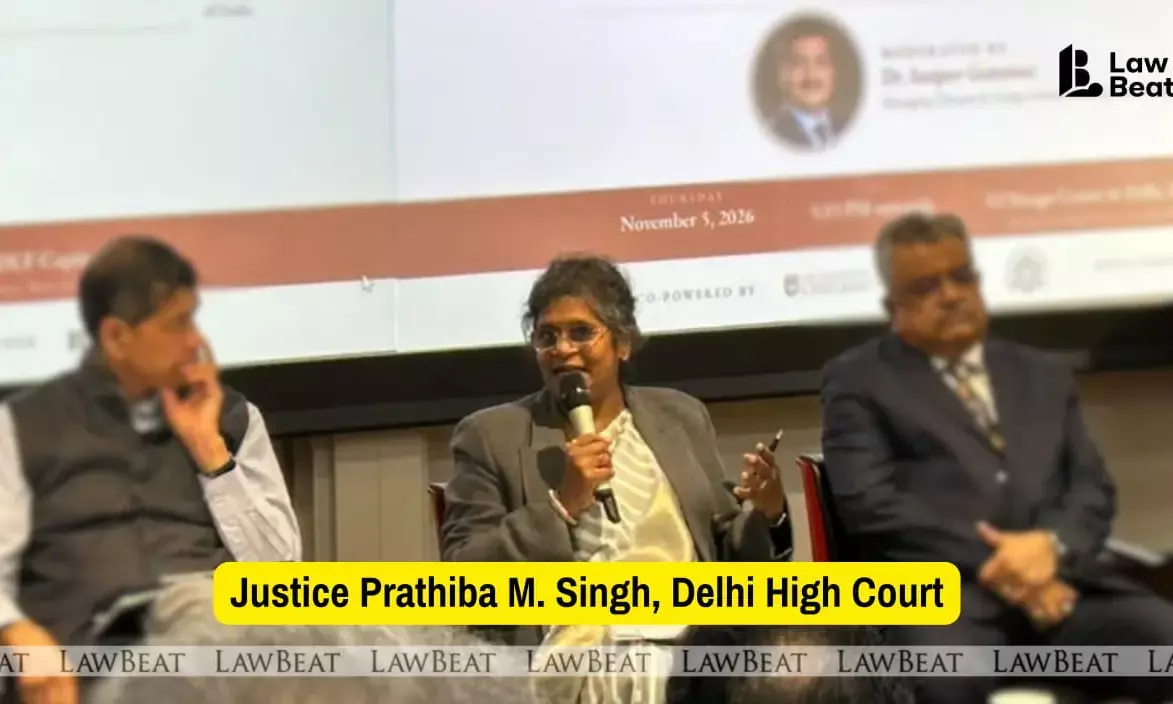
Delhi High Court Justice Prathiba M. Singh has said she has “no doubt” that India needs uniform intellectual property (IP) courts across the country, arguing that a dedicated stream would bring trained judges and a predictable body of law.
She was speaking at a session titled “Shaping the Legal Architecture of Viksit Bharat: The Supreme Court and India @ 2047”. Justice Singh began with a disclaimer that her views were personal and not made as a judge.
Asked whether India needs dedicated IP courts, since commercial courts also handle IP matters, she said the country should create them “even if it means adding maybe a small chapter into the Commercial Courts Act”. She said dedicated commercial courts had done “a huge service to the country in the last 11 years”.
“If we have district court, from district courts till the High Court and the Appellate Division, dedicated IP stream of courts, it is really going to help, because in that sense, then they can have proper training, and proper jurisprudence will evolve,” she said. According to her, this would give the country “a predictable, uniform jurisprudence”.
From “developing country” label to IP success story
Earlier, responding to a question on how India can reassure domestic and global industry, Justice Singh traced the country’s IP journey. She recalled that India labelled itself a developing country when the global trade agreements were negotiated, which gave it extra time to comply with the TRIPS Agreement. While developed countries had a 1995 deadline, India got until January 2005.
India implemented TRIPS “rather reluctantly”, she said. But she added that the last 21 years show India “is a success story on intellectual property”. She said India is among the top five destinations in the world for IP enforcement.
She credited three reforms. The first was the judiciary’s “very, very innovative remedies”, since courts cannot create laws but can “within the existing legal framework and architecture, innovate remedies”. She pointed to well-known trademarks, transborder reputation and passing off in domain names, where Indian courts sometimes ruled before UK or US courts.
The second was the Commercial Courts Act. Justice Singh recalled that she had appeared before the Joint Parliamentary Committee as a lawyer, where some members asked why a “rich man’s court” was needed when criminal cases were pending. She said district commercial courts in Delhi now take about one to one and a half years to decide a commercial dispute.
The third was the creation of IP Divisions, starting with the Delhi High Court and followed by Madras, Himachal Pradesh and Calcutta. She said Bombay may be in the process and Gujarat has a separate IP roster.
She said courts have “left no stone unturned” in enforcing IP, through John Doe orders, Anton Piller orders, dynamic injunctions and action against e-commerce counterfeiting. Trademark and copyright matters, she said, often get resolved within about a year of filing.
On patents, she said India was heavily criticised after the Novartis judgment of April 1, 2013, but later “COVID showed that almost all the developed world went the India way”. On standard essential patents, she said India is now the fourth top jurisdiction in the world. In her view, the reason is also economic: telecom companies “can never even afford” to exit India, one of their biggest markets.
Reduce government litigation, adopt technology
Justice Singh said the courts’ time should go mainly to private disputes, and that “we need to reduce the amount of governmental litigation in our courts.”
She added that “without technology, law cannot function anymore”. She called for more law schools offering technology-plus-law degrees, like IIT Kharagpur. At a recent World IP Forum in Geneva on artificial intelligence, 800 judges took part, and “52% of the judges said that they want to use AI for drafting judgments”, she said, because of “huge crunch of time”.
“Society’s needs also need to be made aware to the judges”
Justice Singh also welcomed more direct conversation between judges, economists, industry and investors. “We, as judges, cannot be shielded. We need to know the realities, and the realities of judges should also be known too,” she said.
She said every debate raises the question of why judges take so much vacation, but “citizens don’t know how much work is put in”. She added that society must be made conscious of how much judges work, and judges must in turn be made aware of society’s needs.
Solicitor General Tushar Mehta on the panel backed her. He called the criticism that judges take long vacations “absolutely wrong”, saying judges work from early morning till late night and use only about a week of their vacation, devoting the rest to writing judgments.