
LawBeat Founding Editor Sanya Talwar Speaks At NCW's National POSH Act Awareness Programme
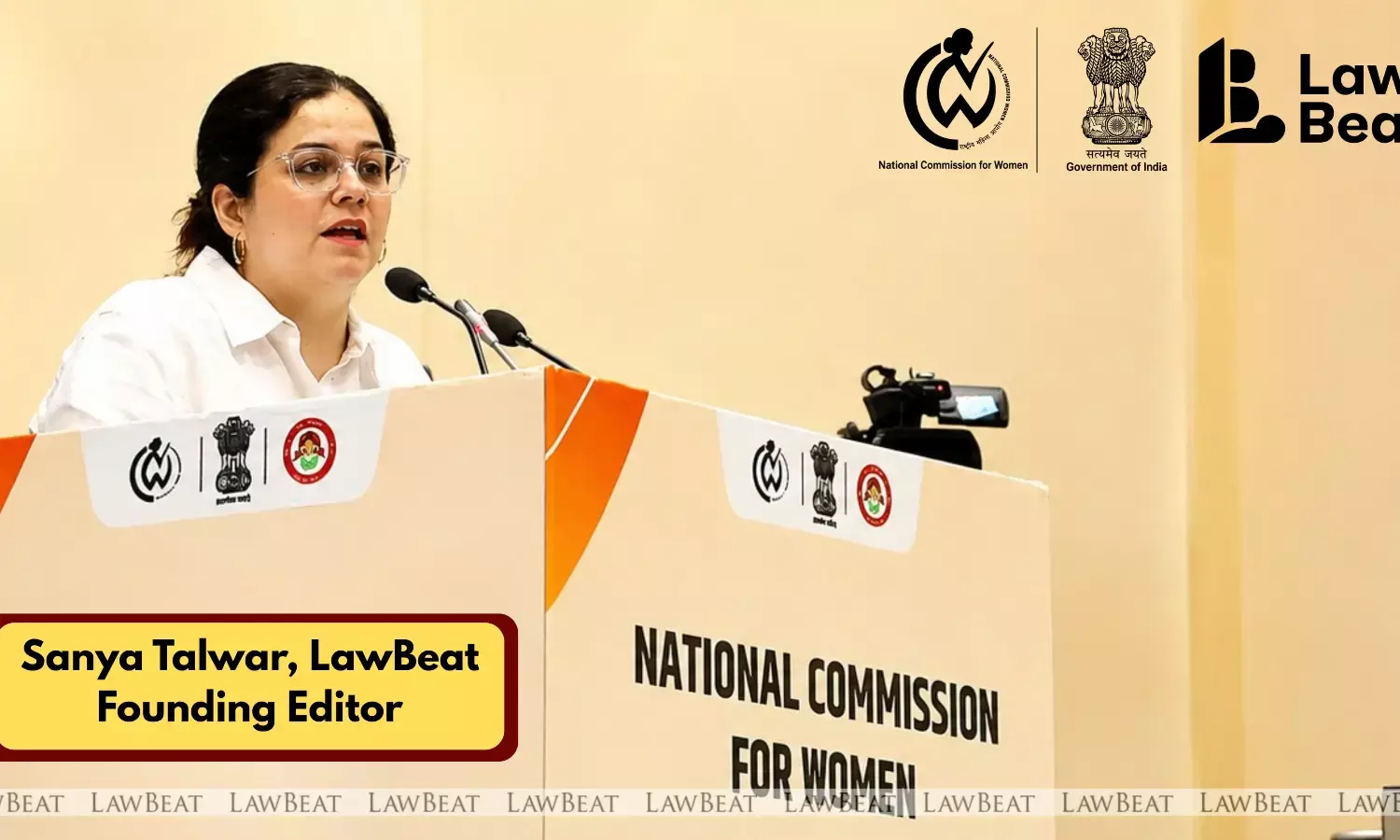
LawBeat Founding Editor Sanya Talwar addressed the National Commission for Women's National Awareness Programme on the POSH Act at Vigyan Bhawan, New Delhi.
LawBeat Founding Editor Sanya Talwar was invited as a speaker at the National Commission for Women's (NCW) two-day National Awareness Programme on the Sexual Harassment of Women at Workplace (Prevention, Prohibition and Redressal) Act, 2013, which commenced on Friday at Vigyan Bhawan, New Delhi.
The programme, organised by the NCW, brought together legal experts, policymakers, judicial officers, corporate representatives and Internal Committee members to deliberate on the implementation and evolving challenges under the POSH Act.
Addressing the gathering, Talwar delivered a session on the Overview of the POSH Act and the Rights of Complainants and Respondents, emphasising that the legislation is fundamentally about respecting personal boundaries and fostering safe workplaces.
She described the POSH Act as a civil law designed to safeguard dignity at the workplace, noting that the legislation deliberately avoids prescribing an exhaustive list of acts constituting sexual harassment because personal boundaries differ from individual to individual.
"The soul of the law is that every person's boundaries, regardless of gender, deserve respect," she observed.
Talwar explained that while the law does not expect individuals to "read minds", it does require them to exercise judgment, empathy and professionalism in workplace interactions.
Highlighting the subjective nature of workplace conduct, she said sexual harassment arises where behaviour is unwelcome, carries a sexual element, and affects the dignity of the person concerned.
She elaborated on the forms of sexual harassment recognised under the POSH Act, including physical contact and advances, demands or requests for sexual favours, sexually coloured remarks, showing pornography without consent, and other unwelcome verbal, non-verbal or physical conduct such as staring, whistling or making suggestive gestures. According to Talwar, sexually coloured remarks remain among the most frequently encountered forms of workplace sexual harassment.
Referring to judicial developments, Talwar noted that the Delhi High Court has recognised social media as an extension of the workplace, meaning acts of sexual harassment committed through digital platforms may also attract the provisions of the POSH Act.
She also discussed the concepts of quid pro quo harassment, where sexual favours are sought in exchange for workplace benefits such as promotions or appraisals, and hostile work environment, where repeated unwelcome conduct with a sexual element creates an intimidating or offensive workplace.
At the same time, Talwar clarified that the POSH Act does not cover every workplace dispute. Conduct such as consensual interactions, sexism without a sexual element, workplace bullying lacking sexual overtones, excessive workload, discrimination based on competence or merit, and ordinary professional disagreements do not automatically amount to sexual harassment under the Act.
Emphasising the importance of procedural fairness, Talwar stated that the POSH Act equally protects the rights of both complainants and respondents, ensuring that the inquiry process remains balanced and fair.
She further explained that complaints under the Act are not restricted to employees alone and may also be filed by visitors or third parties, provided the complainant is a woman above the age of 18. She also highlighted judicial precedents recognising that complaints can be filed against women as respondents, including the Bombay High Court's decision in Jaya Kodate v. Rashtrasant Tukdoji Maharaj Nagpur University, and that complaints may also arise in educational institutions involving students and teachers.
The two-day programme commenced with an inaugural session that included an opening address by NCW Chairperson, Vijaya Rahatkar and an address by the Chief Guest, Union Minister for Women and Child Development, Annpurna Devi, before proceeding to the technical sessions.
The programme is expected to conclude with further deliberations on institutional preparedness, grievance redressal mechanisms, and measures to strengthen compliance with the POSH Act across government and private workplaces nationwide.
Event Name: Awareness Program On POSH Act, 2013
Event Date: July 17, 2026