
No Law Prohibits Eating Chicken Over The Ganga: Justice Ujjal Bhuyan Questions Arrests, Delayed Bail In Varanasi Iftar Case
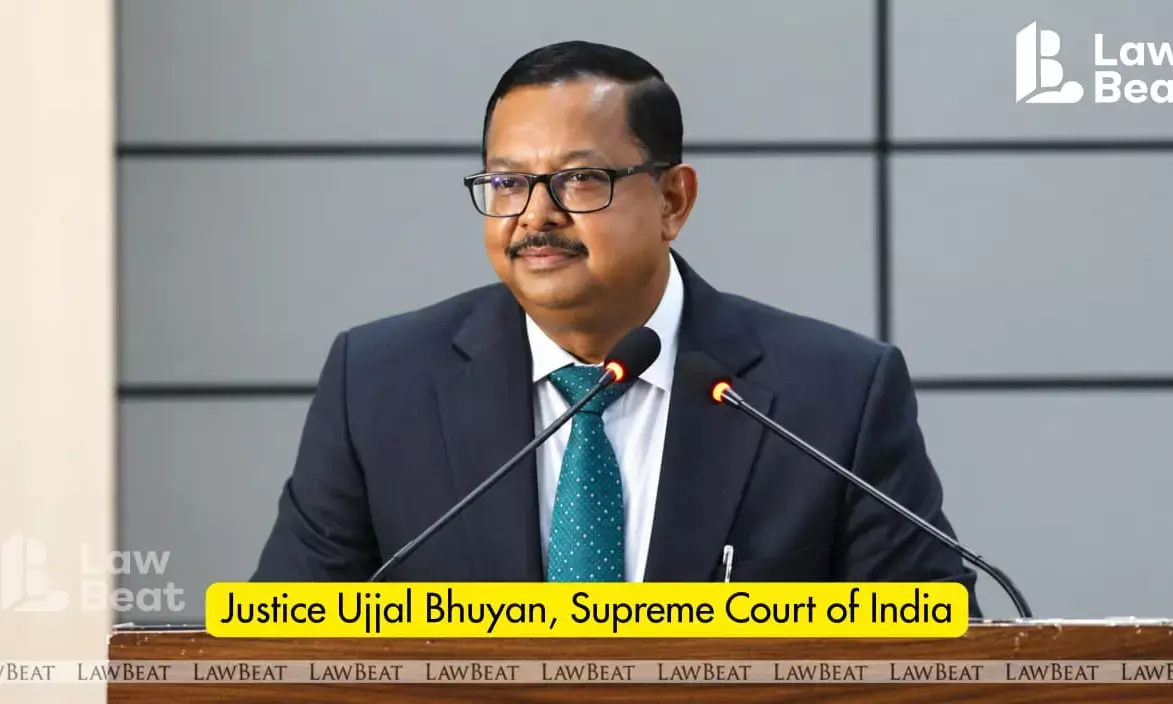
Justice Ujjal Bhuyan Questions Arrests in Varanasi Iftar Biryani Case, Warns Against Democratic Dissent
Using the arrest of eight men in the Varanasi Iftar Chicken Biryani case in March this year as a significant illustration, Supreme Court judge Justice Ujjal Bhuyan on Saturday raised concerns over the shrinking space for democratic dissent, asking whether courts were "indirectly telling" citizens or discouraging them from expressing dissent.
Delivering the 4th Justice G.P. Singh Memorial Lecture at the National Law Institute University (NLIU), Bhopal, Justice Bhuyan said constitutional courts are duty-bound to safeguard liberty and ensure that the criminal justice system does not become a means to silence dissent.
Referring to the Varanasi iftar case, Justice Bhuyan recalled that a group of ‘youngsters’ had been arrested after breaking their fast by consuming chicken biryani on the banks of the Ganga. Questioning both the arrests and the prolonged incarceration that followed, he remarked:
"I'm sure consuming chicken biryani is not an offence. Can't be an offence. There's no law prohibiting consumption of chicken over the Ganga River. They were arrested for that very reason and they had to remain in jail for three months. Three months. Can you imagine?"
Noting that the accused secured bail only after three months, he asked: "Can people be arrested and denied bail for three months for such an activity? I ask myself."
According to Justice Bhuyan, such instances raise a larger constitutional concern: "Are the courts indirectly telling the citizens or discouraging the citizens not to express their dissent?"
The judge observed that while courts eventually grant relief in many such cases, it often comes after citizens have already undergone prolonged incarceration. He also expressed concern over the increasing tendency to impose restrictive conditions while granting bail.
Illustrating what he described as increasingly restrictive bail jurisprudence, Justice Bhuyan also cited a case where anticipatory bail was granted to a person accused over a Facebook post criticising a minister's remarks concerning the daughter of an Army officer. Referring to the condition requiring the accused to surrender his passport, he observed that there was no allegation that the accused posed a flight risk.
He also referred to cases where students and activists, after spending weeks in custody, were granted bail subject to conditions restraining them from posting on social media, speaking publicly on the issues involved or participating in public meetings.
Such conditions, Justice Bhuyan said, substantially curtail personal liberty and fundamental freedoms. He said: "Citizens are watching. The world is watching."
He further observed that criminal law was increasingly being invoked against citizens participating in peaceful public causes.
Pointing to environmental activists being "chased away as if they are criminals" and students being arrested during campus protests before securing bail weeks later, Justice Bhuyan suggested that these developments warranted judicial introspection.
Justice Bhuyan then turned to the role of universities, emphasising that institutions of higher learning must encourage students to question prevailing ideas rather than discourage uncomfortable conversations.
He urged universities to foster inquisitiveness and critical thinking, observing that students should not merely reproduce accepted views but should critically analyse laws, judgments and public policies.
According to him, judicial decisions, including those of the Supreme Court, must also remain open to informed academic criticism. As an illustration, Justice Bhuyan referred to the situation in Gaza.
Noting that India has historically recognised Palestine, he observed that South Africa had approached the International Court of Justice seeking a declaration that the violence in Gaza amounted to genocide. He also referred to a United Nations report documenting violence against women, children, the elderly and other civilians in the region.
"These are issues which should agitate the mind of a student, of a research scholar. You must read, you must question. That is the place of a university."
Clarifying that he was not suggesting students debate only Gaza, Justice Bhuyan stressed that universities must remain spaces where difficult constitutional, social and global issues can be discussed freely.
Continuing on the same theme, he referred to a case before the Bombay High Court arising from the denial of permission for a demonstration at Mumbai's Shivaji Park in solidarity with the people of Gaza.
Recalling the proceedings, Justice Bhuyan said he found it "very amusing" that the court had reportedly asked the organisers: "Don't you have any issues in India? Why do you have to go that far to agitate?"
He said citizens in a constitutional democracy should not be discouraged from peacefully expressing solidarity with causes merely because they concern events beyond India's borders, adding that universities should encourage, rather than stifle, such engagement.
The lecture then broadened into a discussion on constitutional governance, with Justice Bhuyan underscoring that the protection of liberty ultimately rests upon a robust separation of powers and an independent judiciary.
Explaining the doctrine of separation of powers through the analogy of a three-legged stool, he said democracy remains stable only when the legislature, executive and judiciary function independently while acting as checks and balances on one another.
Against that backdrop, Justice Bhuyan criticised the justification offered by a former Chief Justice of India for accepting a Rajya Sabha nomination.
"When a former Chief Justice of India says I am going to the Rajya Sabha to bridge the gap between judiciary and the executive, it is fundamentally wrong. It is completely wrong. It goes against the principle of separation of powers."
Describing judicial independence as part of the Constitution's basic structure, Justice Bhuyan reminded judges that the responsibility of protecting the rule of law ultimately rests with the judiciary.
"If the judges do not protect independence of the judiciary, who else will protect it? If the judges do not enforce the rule of law, who else will?" he said.
Concluding his address, Justice Bhuyan said the judiciary derives neither authority from the purse nor from the sword but from the confidence reposed in it by the people. "The only thing that the judiciary has and which sustains it is the faith of the people" he said.
He added that the Supreme Court's legitimacy depends not on judges proclaiming the institution's greatness but on how citizens perceive its commitment to constitutional values, liberty and justice.