
Breaking: Delhi HC Denies Anticipatory Bail To Ajeet Bharti In SC-ST Act Case Over Remarks On MP Chandra Shekhar
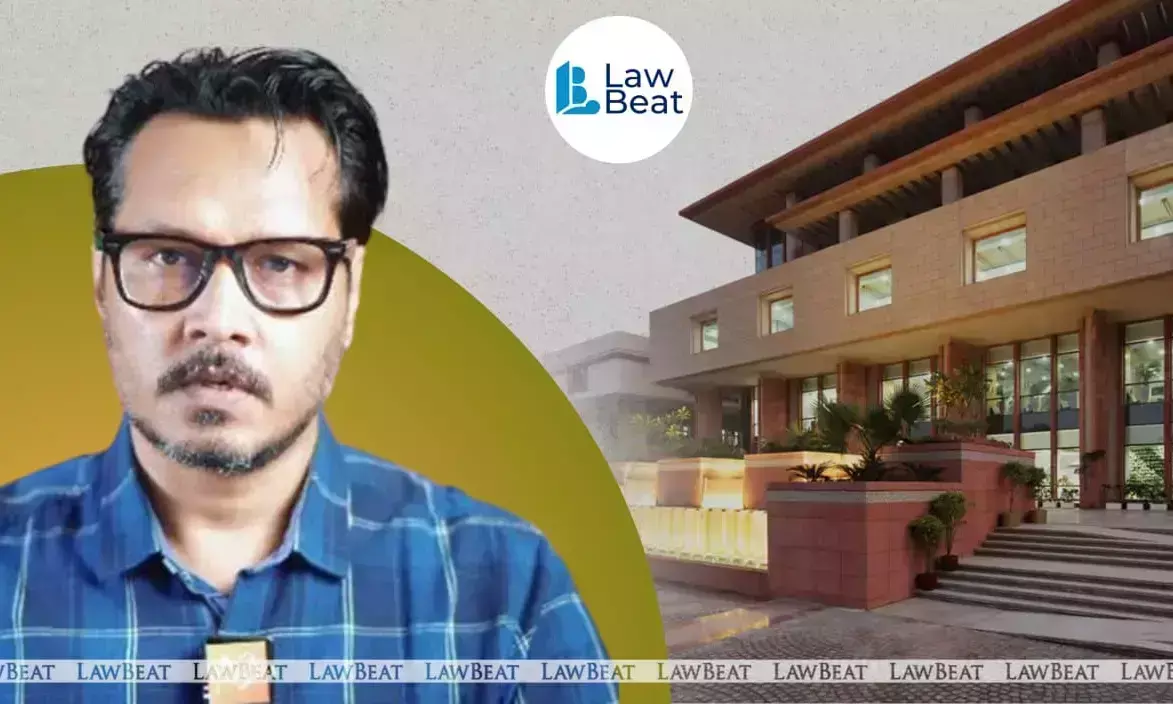
Justice Saurabh Banerjee dismissed the petition saying the petition is not maintainable in view of bar under SC-ST Act
Delhi High Court denies anticipatory bail to YouTuber Ajeet Bharti in a case registered under the SC-ST Act over alleged objectionable remarks made during a YouTube broadcast concerning Nagina MP Chandrashekhar Azad.
Justice Saurabh Banerjee dismissed the petition, saying: "SC ST Act to be prima facie made out against the applicant, considering the statutory bar of the Act that there is a clear legal position. The present petition seeking grant of anticipatory bail being not maintainable is dismissed".
A detailed order is awaited.
Bharti approached the Delhi High Court after Additional Sessions Judge Saurabh Pratap Singh Laler of the Patiala House Court rejected his anticipatory bail plea on September 7.
While denying pre-arrest bail, the Sessions Court held that the material prima facie disclosed an offence under Section 3(1)(r) of the SC/ST Act, attracting the statutory bar on anticipatory bail under Section 18.
The FIR
The FIR was registered on a written complaint by the Delhi State President of a registered political outfit, who was not personally present at any physical occurrence; the FIR records the place of occurrence "on social media."
It alleges that Bharti, through his verified account on X (@ajeetbharti) and on YouTube, published an episode of his self-titled programme on August 22, 2026 at about 22:11 hrs, which had garnered approximately 23,100 views by the date of the complaint.
The episode was alleged to contain statements "casteist, derogatory and humiliating towards persons of the Scheduled Caste community," towards Chandra Shekhar Azad, and towards Dr. B.R. Ambedkar, along with statements "alleged to be sexually degrading and intimidatory."
The FIR invoked Sections 3(2)(va)/3(1)(r)/3(1)(s)/3(1)(u)/3(1)(v)/3(1)(w) of the SC/ST Act, Section 67 of the Information Technology Act, 2000, and Section 196(1)(c)/351(3) of the Bharatiya Nyaya Sanhita, 2023.
The order of the Trial Court stated: "The assertion that the said MP should make himself worthy of marrying an upper caste girl, is a specific reference to cast and humiliating as to why a person fit to be married to anyone in SC / ST community has to be something extra / something more / worthy of marrying a girl in upper cast."
Denying him the relief, the trial Court had said: "This Court finds that the ingredients of an offence under Section 3(1)(r) of the Scheduled Castes and the Scheduled Tribes (Prevention of Atrocities) Act, 1989 are prima facie disclosed on the material on record, and that the bar under Section 18 of the Act, 1989 accordingly precludes the grant of anticipatory bail to the applicant." The application was accordingly dismissed.
During the hearing before the High Court, Bharti’s counsel, Advocate Jai Anant Dehadrai, had submitted before the Court that the alleged remarks forming the basis of the FIR had to be considered in their complete context, including the portions of the video preceding and following the impugned statements.
The counsel said Bharti’s primary source of income was through short videos and podcasts uploaded on YouTube, with some content also being published as reels.
Dehadrai thereafter sought to explain the circumstances in which Bharti had allegedly made the remarks.
"Because I am an anti-caste discrimination activist. So I have spoken against caste discrimination. Somebody posts something about my sister, my married sister, says something offensive. In provocation and reaction, I say something " he submitted.
He added that there was no intention to denigrate any caste or humanity.
Dehadrai further urged the Court to watch the portions of the video before and after the allegedly objectionable remarks. " The impugned portion is a few lines, please hear also the part that comes prior, and after " he submitted.
During the hearing, Justice Banerjee also made observations concerning the manner in which persons who publicly disseminate opinions through online platforms should conduct themselves.
Justice Banerjee observed: "But once you designated yourself as a Youtube Commentator, you should be aware of what you are, and how you are, and when you are, and what you are doing."
The Court observed that there was no prescribed professional qualification for being a YouTuber and that the nature of the role was essentially something created by the person themselves.
"There is no written prescribed norm. You are what you have created yourself. You haven't had a professional degree or degree or something. So you might as well know what you're doing " the Judge said.
The Court had further observed that while expressing opinions through podcasts or other programmes, a person could not necessarily "come up to a level of expressing your opinion by naming", indicating that this could present an issue in the context of the present case.
"You can't, in under these podcasts or programs or dissemination, you can't come up to a level of expressing your opinion by naming. That is the only point which might come in a problem with you " Justice Banerjee had said.
Justice Banerjee also stressed that where statutory provisions confer special protections, a person making public statements must exercise caution.
"But where there are some issues, and where there is a statute which give special privileges which are defined, then you need to be circumspect of what you are doing" the Court had said.
The State also alleged that Bharti had multiple FIRs and "willfully does like these acts".
The State counsel thereafter submitted that the allegedly offensive portion was "exclusively narrated in the FIR".
Case Title - AJEET BHARTI v STATE OF NCT OF DELHI AND ANR
Next Story