
Can State Pay Different Compensation For Similar Incidents? Allahabad HC Orders Uniform Policy
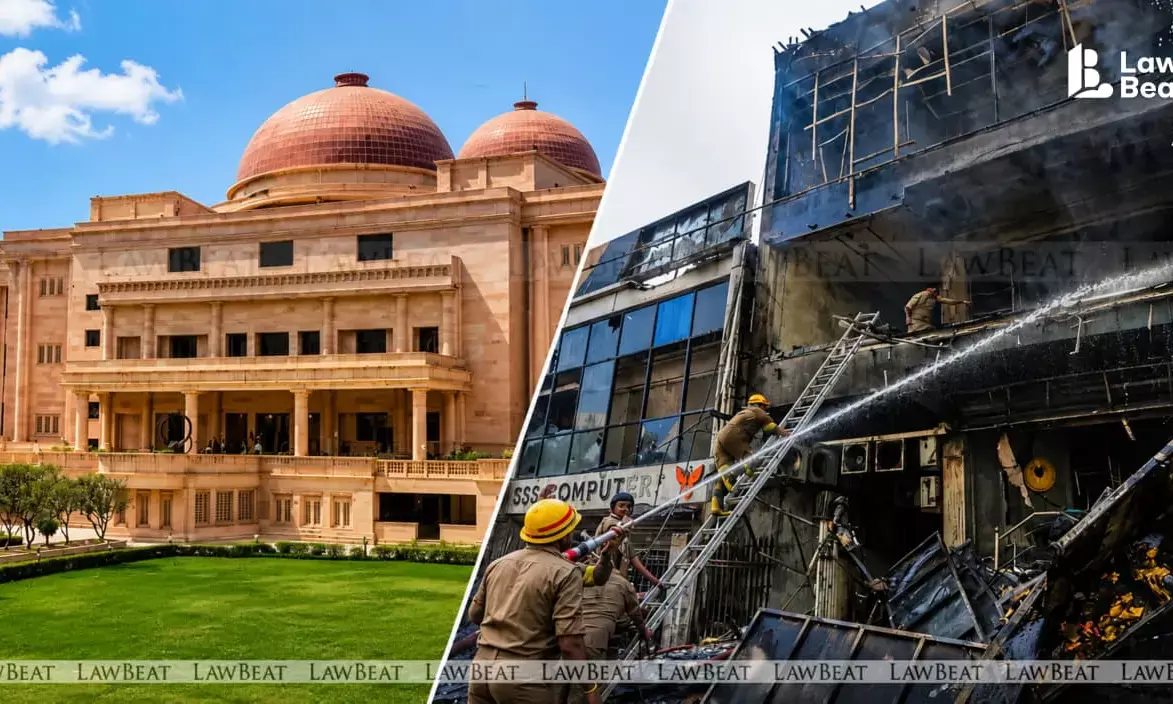
Allahabad High Court seeks uniform compensation policy for fire victims.
The Allahabad High Court has directed the Uttar Pradesh government to formulate a policy laying down clear parameters for payment of compensation in cases where the State grants compensation outside the existing policy for natural calamities and beyond specific statutory provisions.
A division bench of Justices Rajan Roy and Manjive Shukla passed the direction while hearing a public interest litigation filed by Advocate Shivendu Pandey following a fire in June this year at a Housing and Animation Centre in Aliganj, Lucknow, in which 15 young persons lost their lives and several others suffered injuries or disability.
Uniform compensation policy
Court noted that different amounts of compensation had been paid by the State in different incidents. In an earlier order, it had recorded that Rs 12 lakh had been paid to each deceased person from different departments and questioned the basis on which the State determined the quantum of compensation.
The bench observed that compensation in some cases was around Rs 50 lakh, in others Rs 25 lakh, while in the case before it, it was only a few lakhs. It asked the State to explain whether any policy existed to determine compensation for death or injury caused by a fire or other such incidents.
The State subsequently informed the court that its existing policy for payment of compensation covered natural calamities, but did not cover incidents such as the fire in question.
The high court then directed the State government to formulate a policy for compensation in cases falling outside statutory provisions.
Court said that wherever the State grants compensation outside the purview of statutory provisions, there should be a policy laying down parameters for determining the amount. Such a framework, it said, was necessary “to avoid discrimination and arbitrariness” and to ensure that a less deserving case did not receive more compensation than a more deserving one.
Supreme Court judgments on fire incidents
The bench was also apprised of three Supreme Court decisions concerning compensation in fire incidents which were Sanjay Gupta vs. State of U.P. (2022), DAV Managing Committee and Anr. vs. Dabwali Tragedy Victims Association & Ors. (2013) and Municipal Corporation of Delhi vs. Uphaar Tragedy Victims Association (2011).
These judgments have held that where there is no policy or statutory framework for compensation, principles applicable to motor accident claims can be applied while determining and paying compensation.
The high court directed the State to keep these rulings in mind and file an affidavit explaining the compensation already paid to the victims' families and why the compensation should not be enhanced.
The families of the victims had intervened in the proceedings, contending that the compensation paid by the State was inadequate. The State said the victims had received about Rs 11 lakh from different sources, including Rs 5 lakh from the Chief Minister's Discretionary Fund, Rs 4 lakh from the State Disaster Response Fund and Rs 2 lakh from the Prime Minister's Relief Fund.
However, the families said some of them had not received the Rs 2 lakh from the Prime Minister's Relief Fund. Court directed the Union government to verify the position.
State directed to pay injured victim’s medical expenses
Court also considered the case of a 25-year-old injured person who was undergoing treatment at King George's Medical University and was incurring expenses of around Rs 70,000 every month. The court was told that he had received only Rs 50,000 as compensation.
The bench observed that the incident appeared to have occurred not only because of a lapse on the part of the building owner but also due to lapses by authorities in allowing the building to be constructed and used for commercial purposes illegally.
“Least that the State can do” was to pay the injured person's medical bills, court said. It directed the concerned State department to make the necessary payment and ordered KGMU not to charge the injured person for his treatment.
Court said that any expenses required for his treatment should be demanded from the State government, which must ensure their payment. “The patient shall not be made to pay for his treatment,” it directed.
Court also permitted the petitioner to implead the building owner as a party and issued notice to the newly added party. The matter has been listed for further hearing on October 15.
Case title: Shivendu Pandey v. State of U.P. through Additional Chief Secretary/Principal Secretary, Home Department, Lucknow & 11 Others
Order date: September 9, 2026
Bench: Justice Rajan Roy and Justice Manjive Shukla