
Bombay High Court Sentences Tarun Tejpal To 10 Years' Rigorous Imprisonment In 2013 Rape Case
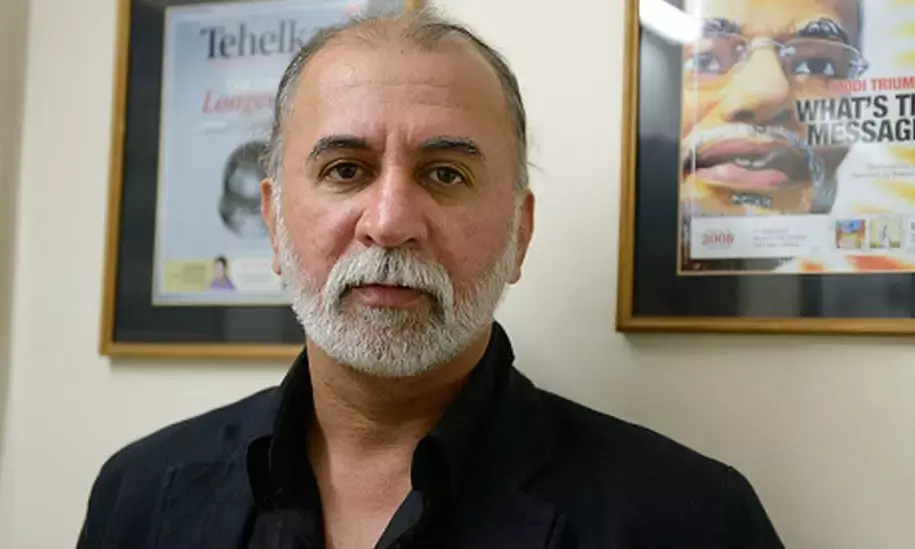
Ex-Tehelka editor Tarun Tejpal faces 10 years in prison after the Bombay High Court's Goa Bench reversed his 2013 rape-case acquittal.
The Goa Bench of the Bombay High Court on Thursday sentenced former Tehelka Editor-in-Chief Tarun Tejpal to 10 years' rigorous imprisonment in the 2013 rape case lodged by his former junior colleague, while observing that "both parties must have by now moved on in their lives."
After noting that Tejpal had remained on bail throughout the proceedings without violating any bail conditions and that his passport had remained with the authorities, the Court granted him two weeks' time to surrender following his conviction earlier in the day.
A Division Bench of Justice Neela Gokhale and Justice Amit Borkar Jamsandekar directed that Tejpal undergo 10 years' rigorous imprisonment under both Sections 376(2)(f) and 376(2)(k) of the Indian Penal Code (IPC), with the sentences to run concurrently.
Court also imposed a fine of ₹5 lakh under each of the two rape charges and directed that the entire fine amount be paid to the survivor.
Sentence Awarded To Tarun Tejpal
Pronouncing the sentence after hearing both sides on the question of punishment, the Bench observed that the incident had taken place around 13 years ago, that Tejpal was now a senior citizen with a wife and two daughters, and that there had been no allegation of any misconduct by him after the acquittal.
"Both parties must have by now moved on in their lives," the Court observed before proceeding to impose sentence.
Apart from the 10-year prison terms under Sections 376(2)(f) and 376(2)(k), the Court also sentenced Tejpal to:
• One year's rigorous imprisonment and a fine of ₹10,000 under Section 354 IPC;
• One year's rigorous imprisonment under Section 354A IPC;
• Three years' rigorous imprisonment and a fine of ₹10,000 under Section 354B IPC;
• Fine of ₹500 each under Sections 341 and 342 IPC, with default sentences.
Court directed that all sentences would run concurrently. It further ordered that the entire fine deposited by Tejpal be paid to the survivor and directed the Police Inspector, CID Crime Branch, North Goa, to file a compliance report regarding deposit of the fine within three months.
Accepting Tejpal's request for time to approach the Supreme Court, the Bench granted him two weeks to surrender, directing that his existing bail bonds would continue till then or until he is arrested.
Tejpal Sought Leniency
Before the sentence was pronounced, senior advocate Aabad Ponda, appearing for Tejpal, urged the Court to adopt a lenient approach.
He submitted that Tejpal had remained on bail throughout the proceedings without breaching any condition, was a senior citizen with a good social record, and had never travelled abroad as his passport remained with the authorities.
Ponda argued that the minimum sentence be awarded, adding that Tejpal intended to challenge the conviction before the Supreme Court and therefore sought eight weeks' time to surrender.
Addressing the Court personally, Tejpal claimed that he was a "political victim" in the case, stating that he had presented all the facts before the Court. Referring to his family, including his wife and two daughters, he requested the Bench to take a lenient view while deciding the sentence.
State Pressed For Maximum Punishment
Opposing the plea for leniency, Solicitor General Tushar Mehta, appearing for the State of Goa, urged the Court to award the maximum punishment prescribed by law.
Mehta submitted that the accused occupied a position akin to that of a father vis-à-vis the prosecutrix, who was not only of his daughter's age but was also a close friend of his daughter.
"The punishment must have a deterrent effect," the Solicitor General submitted, adding that this was "one of the very peculiar circumstances" emerging from the case.
He further argued that the accused displayed "no remorse" and, according to the prosecution case, repeated the conduct on the following day despite the victim's resistance.
"He was brazen despite resistance, despite the victim saying no. His behaviour was brazen," he submitted.
The Solicitor General also objected to the defence's attempt to portray the prosecutrix's conduct after the incident as inconsistent with that of a victim of sexual assault.
He argued that the prosecutrix's mature and composed behaviour had been wrongly projected as though she had "enjoyed the molestation," contending that such reasoning could not operate to the benefit of the accused.
"The punishment should be commensurate with the relationship which they had," Mehta submitted.
Concluding his submissions, he urged the High Court to send a clear constitutional message on sexual consent.
"It is high time where the highest constitutional court of the State pronounces by giving him the maximum sentence that no means no. You may be in a dominant position...whosoever you are, but when a girl says no, it means no," he submitted.
Conviction
Earlier today, the High Court convicted Tejpal by overturning the trial court's judgment that had acquitted him in May 2021.
After the conviction, Mehta had urged the Court to award the maximum punishment, while the defence sought suspension of the conviction for eight weeks to enable Tejpal to approach the Supreme Court.
Ponda had argued that the alleged offence dated back to 2013, that Tejpal had remained at liberty after his acquittal without ever misusing bail, and that there were conflicting findings between the trial court and the High Court.
"The man has never absconded...I can't run away from this country, or I can't run away from the law," Ponda had submitted, adding that there was no necessity to take him into custody immediately.
The prosecution opposed any stay on the conviction or sentence and urged that Tejpal be taken into custody, leaving it open to him to seek bail before the Supreme Court.
Background
A complaint was filed against Tejpal for sexually assaulting his colleague in a hotel in Goa in November 2013.
Tejpal was charged with offences punishable under Sections 341 (wrongful restraint), 342 (wrongful confinement), 354 (assault or criminal force with intent to outrage modesty), 354-A (sexual harassment), 354-B (assault or use of criminal force to woman with intent to disrobe), 376(2)(f) (person in a position of authority over women committing rape) and 376(2)(k) (rape by a person in a position of control) of the IPC.
He was acquitted by the trial court in May 2021, following which the State of Goa challenged the acquittal before the Goa Bench of the Bombay High Court. On Thursday, the High Court allowed the State's appeal, convicted Tejpal and sentenced him to 10 years' rigorous imprisonment.
Case Title: State of Goa v Tarunjit Tejpal & Anr