
'AI Should Aid, Not Replace Human Reasoning': Supreme Court on Fake Case Law
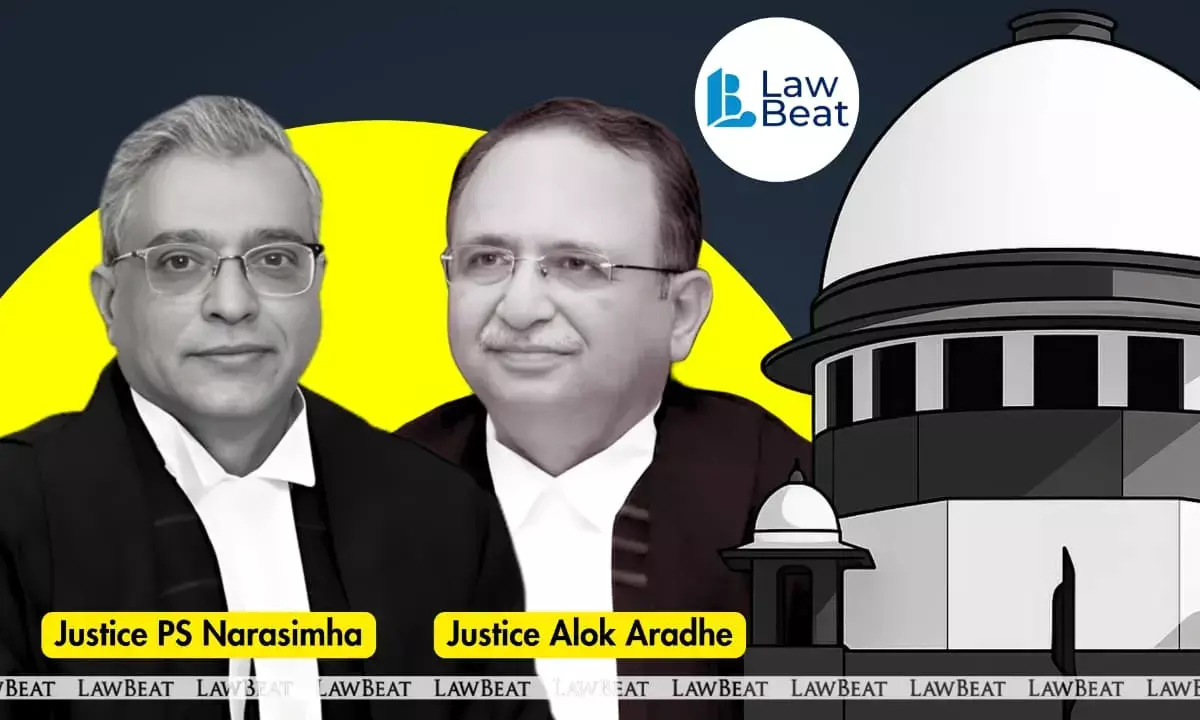
Supreme Court flags dangers of AI-hallucinated judicial precedents.
The Supreme Court recently cautioned that the rise of AI-generated fake case law could fundamentally alter courtroom practice, observing that it would be untenable if judges were forced to verify the authenticity of every precedent cited by lawyers before deciding a case.
The observation came while a Bench of Justices P S Narasimha and Alok Aradhe set aside orders passed by the National Company Law Tribunal (NCLT) and the National Company Law Appellate Tribunal (NCLAT) after finding that the adjudicating authority had relied on non-existent and AI-hallucinated judicial precedents.
Noting that the fake authorities had escaped scrutiny not only before the NCLT but also at the appellate stage, Court highlighted the practical challenge posed by AI-generated fabricated case law.
"What about the Appellate Tribunal?" the Bench asked, observing that today's courts and tribunals implicitly trust lawyers when they cite judicial precedents. It then remarked, "Imagine the hardship of a situation in which the Court must verify the authenticity of each judgment cited by an advocate".
Court made the observation while hearing an appeal arising out of insolvency proceedings initiated by Jammu and Kashmir Bank Ltd against Essel Infraprojects Ltd (EIL), which had stood as the corporate guarantor for its subsidiary, Pan India Utilities Distribution Company Ltd. The NCLT had admitted the bank's application under Section 7 of the Insolvency and Bankruptcy Code, 2016, and the NCLAT had affirmed that decision.
Before the Supreme Court, senior advocate Madhavi Divan, appearing for the appellant, pointed out that several judgments relied upon by the NCLT were either entirely non-existent or contained AI-generated passages wrongly attributed to genuine Supreme Court decisions.
An independent examination by the Court confirmed the allegation. It found that some authorities cited by the tribunal carried incorrect citations of existing judgments, while others were entirely fictitious. In certain instances, genuine judgments had been cited, but the paragraphs extracted from them did not exist.
Court noted that Jammu and Kashmir Bank had filed an affidavit stating that its counsel had never cited the fake judgments and that the so-called precedents appeared to have been generated during the tribunal's own research. Even then, Court observed, the fabricated authorities escaped scrutiny before the appellate tribunal as well.
Holding that the judicial process had been fundamentally compromised, the bench declared that a decision founded on fake or AI-hallucinated material cannot stand in law.
"The judicial process and the judgment under challenge are tainted by the usage of materials which are said to be precedents, but in reality, they are unreal, fake, and do not exist at all. A decision of a Court or an adjudicating authority based on material which is fake and hallucinated is no decision at all, and it amounts to subversion of the rule of law. Such a decision is unsustainable and has to be set aside at the earliest," Court held.
Beyond the facts of the case, the Bench devoted a substantial part of the judgment to the growing role of Artificial Intelligence in legal practice. While acknowledging AI's potential to improve efficiency, it warned that unregulated reliance on the technology could gradually infiltrate legal practice and judicial decision-making, ultimately replacing independent human reasoning. Court stressed that AI should remain only an aid to adjudication, with human decision-makers retaining complete control over the process.
The Bench reiterated that there would be zero tolerance for the production, citation or reliance upon AI-generated precedents without independent verification. It held that citing such material amounts to professional misconduct by advocates, while judges relying on fabricated precedents commit a serious lapse. Clarifying that its observations do not prohibit the legitimate use of AI, Court said its concern was limited to the presentation of fake or hallucinated material as authentic judicial precedents.
To address the issue institutionally, Court directed the Bar Council of India to constitute a committee to examine the growing problem of AI-generated fake authorities. The committee has been asked to frame guiding principles and recommend disciplinary action against advocates who submit such fabricated material before courts.
Allowing the appeal, the Supreme Court restored Jammu and Kashmir Bank's Section 7 application to the NCLT for fresh consideration. It directed the tribunal to decide the matter afresh, preferably within two weeks, without expressing any opinion on the merits of the insolvency dispute. The parties have also been directed to maintain status quo until the proceedings are concluded.
Case Title: Pooja Ramesh Singh Vs Jammu and Kashmir Bank Ltd & Anr
Bench: Justices P S Narasimha and Alok Aradhe
Date of Judgment: July 2, 2026