
Parking Unlit Heavy Vehicle at Night Is Negligence Per Se: Supreme Court
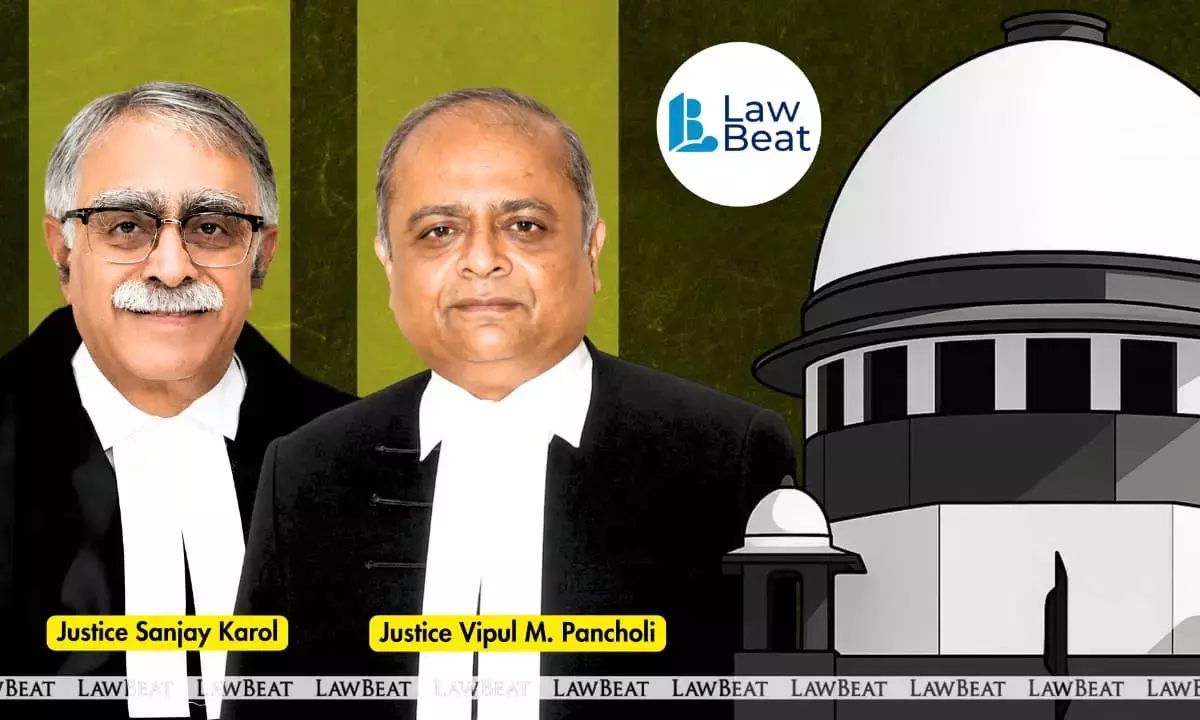
Supreme Court holds unlit parked tanker constituted negligence in fatal crash.
The Supreme Court has held that parking a heavy vehicle on a public road at night without switching on parking lights, hazard indicators or placing reflective warning signs amounts to negligence in itself, as it creates a foreseeable risk to other road users.
Invoking the doctrine of res ipsa loquitur, a Bench of Justices Sanjay Karol and Vipul M Pancholi held that once it is shown that a heavy vehicle was left standing on a road at night without any warning signs, the burden shifts to the vehicle owner to prove that all reasonable precautions had been taken.
"The doctrine of res ipsa loquitur applies where a heavy vehicle is left standing on the roadway at night without warning signs; once such fact is established, the burden shifts to the vehicle owner to prove that all reasonable precautions were taken," the Bench said.
The observation came while allowing appeals filed by Manju Singh and others arising out of the death of three teachers, who were killed after the Maruti car they were travelling in collided with a tanker on the Allahabad-Kanpur highway on the night of January 30, 2002.
The Motor Accident Claims Tribunal (MACT) had dismissed their compensation claims after accepting the defence version that the tanker was stationary on the left side of the road because its conductor had stepped away to attend the call of nature. The respondents had contended that the Maruti car was being driven rashly on the wrong side of the road and had collided with the parked tanker.
Although the tribunal granted compensation under the "no fault liability" principle, it relied mainly on photographs produced by the respondents to conclude that the tanker was parked on the left side of the road. The Allahabad High Court later upheld the Tribunal's findings.
Can photographs taken hours after an accident alone determine negligence?
Answering in the negative, the Supreme Court held that proceedings before a Motor Accident Claims Tribunal are decided on the principle of preponderance of probabilities and not proof beyond reasonable doubt, unlike criminal trials.
"The tribunal is not a criminal court and must appreciate evidence in a pragmatic manner keeping in view the beneficial nature of the legislation," the Bench observed, adding that strict rules of evidence applicable in criminal proceedings do not govern motor accident compensation claims.
Court also rejected the evidentiary value attached to the photographs relied upon by the tribunal and the high court. It noted that the photographs had been taken nearly ten to twelve hours after the accident and had been arranged by the tanker owner without any police supervision.
"Admittedly, the photographs were not taken immediately after the accident. They were taken at about 8:00 a.m. on the following day, nearly ten to twelve hours after its occurrence. Such photographs cannot be treated as an accurate representation of the position of the vehicles at the time of impact/accident," the Bench said.
It held that photographs taken long after an accident, especially when produced by an interested party, cannot by themselves form the basis for deciding negligence.
Why did the court reject the defence version?
The Bench found several circumstances that undermined the respondents' case.
It noted that instead of informing the police immediately after the accident, the tanker driver first contacted the vehicle owner, who then reached the spot and arranged for photographs to be taken. According to the Court, this conduct cast serious doubt on the credibility of the defence version.
On the other hand, Court found the testimony of the sole surviving occupant of the Maruti car, who was also an injured eyewitness, to be reliable. His presence at the spot was undisputed, and as an injured witness, his testimony carried greater evidentiary value unless there were strong reasons to discard it.
He consistently stated that the Maruti car was being driven on the correct side of the road at a normal speed when the tanker came from the opposite direction and collided with it. He also deposed that the car driver had made every possible effort to avoid the accident.
The Supreme Court further noted that the respondents' entire defence rested on the claim that the tanker had been stopped because its conductor had gone to attend the call of nature. However, the conductor, who was the most material witness to support this version, was never examined before the Tribunal.
"Surprisingly, the conductor, who was the most material witness to substantiate this defence, was never produced before the tribunal. No explanation whatsoever was offered for his non-production. An adverse inference must, therefore, be drawn," the Bench said.
Court also highlighted that the accident occurred at around 10 p.m. in January and there was neither any pleading nor any evidence to show that the tanker had switched on parking lights, hazard indicators, reflective signs or any other warning mechanism to alert approaching vehicles.
Holding that the accident occurred due to the rash and negligent conduct of the tanker driver, the Supreme Court declared the concurrent findings of the tribunal and the Allahabad High Court to be "perverse and unsustainable in law".
Allowing the appeals, Court awarded compensation ranging from about Rs 35 lakh to over Rs 65 lakh to the families of the three deceased teachers, along with interest at 6 per cent per annum from the date of filing of the claim petitions until realisation.
Case Title: Manju Singh Vs Avinash Singh & Ors
Bench: Justices Sanjay Karol and Vipul M Pancholi
Date of Judgment: July 13, 2026