
Street Vendors: Supreme Court Says Anti-Encroachment Drives Must Include Vendor Rehabilitation
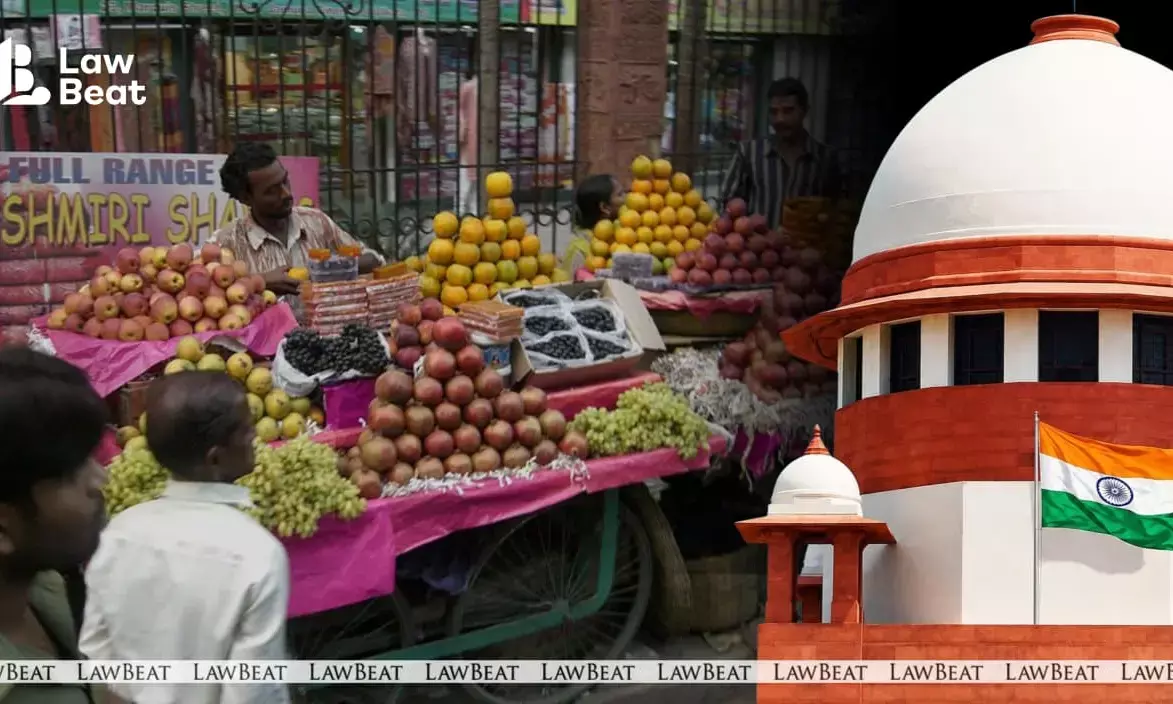
Supreme Court issues directions for Chandigarh's street vending zones.
The Supreme Court has said that authorities carrying out anti-encroachment drives must strike a balance between clearing public spaces and rehabilitating street vendors in designated vending zones.
It stressed that while streets should remain free from unauthorized occupation, the process must protect the livelihood rights of vendors through objective and continuous monitoring rather than relying only on the issuance of challans.
A Bench of Justices Sanjay Karol and N Kotiswar Singh directed the Municipal Corporation, Chandigarh, to ensure that vending zones are made fully operational, equipped with basic public amenities, monitored through CCTV cameras, and that all pending applications and appeals under the Street Vendors Act are decided within a strict timeline.
Court also clarified that administrative notifications issued to deal with temporary situations, such as a national disaster, lose their validity once the circumstances that justified them no longer exist.
It held that the expansion of the category of Essential Service Providers under municipal bye-laws to meet pandemic-related needs cannot continue indefinitely if it defeats the statutory objective of regulating and regularizing street vending.
Accordingly, the Bench quashed the 2020 notification issued under Section 37 of the Street Vendors (Protection of Livelihood and Regulation of Street Vending) Act, 2014, which had expanded the definition of Essential Service Providers during the COVID-19 pandemic to include non-essential food items. Court held that the notification had outlived the purpose for which it was issued.
The directions came while hearing a civil appeal filed by Malkit Singh and another. In an earlier order, Court had observed that the State must ensure minimum disruption to vendors' livelihoods while removing encroachments. It had said that once vending zones are identified, authorities must provide adequate assistance to vendors for relocation, recognising that such relocation affects both their customer base and residents who depend on nearby vendors.
What directions did the Supreme Court issue for Chandigarh's vending zones?
After considering an affidavit filed by the Chandigarh Administration and submissions made by the amicus curiae, the Bench directed that the recently identified vending zones should be operationalized and licensed vendors shifted there at the earliest.
Court said the vending zones should be monitored daily by city officials to ensure smooth functioning. It also directed that adequate road signage in all commonly used languages be installed to help commuters locate the vending zones.
It further ordered that public amenities be established immediately wherever they are lacking, and that proper maintenance be ensured once the facilities become operational. Authorities were also directed to periodically publish advertisements in print and electronic media informing the public about the location of vending zones and their operating timings.
The bench welcomed the issuance of smart cards to vendors and directed that the process be completed expeditiously for all eligible vendors.
What did the Court say on safety and pending applications?
Court directed that details of every vendor, along with their smart card number, be shared with the jurisdictional police stations and the district administration. To ensure the safety and security of both vendors and customers, it ordered that CCTV cameras be installed in all vending zones within six months.
It also asked the authorities to consider setting up a dedicated helpline for vendors and buyers to strengthen confidence in the security and proper regulation of vending zones.
On pending matters, the Bench directed that all pending applications and appeals be decided after giving an opportunity of hearing to all concerned parties. The present batch of pending cases must be decided within 60 days, while fresh applications and appeals should ordinarily be disposed of within 30 days, subject to the provisions of the Street Vendors (Protection of Livelihood and Regulation of Street Vending) Act, 2014 and the applicable bye-laws.
Court directed the Chandigarh Administration to file an affidavit indicating compliance.
Case Title: Malkit Singh And Anr Vs State of UT, Chandigarh & Ors
Bench: Justices Sanjay Karol and N Kotiswar Singh
Date of Judgment: July 1, 2026