
Supreme Court Says Its 'Requests' To Courts, Tribunals Must Be Treated As Directions; Pulls Up NCLAT
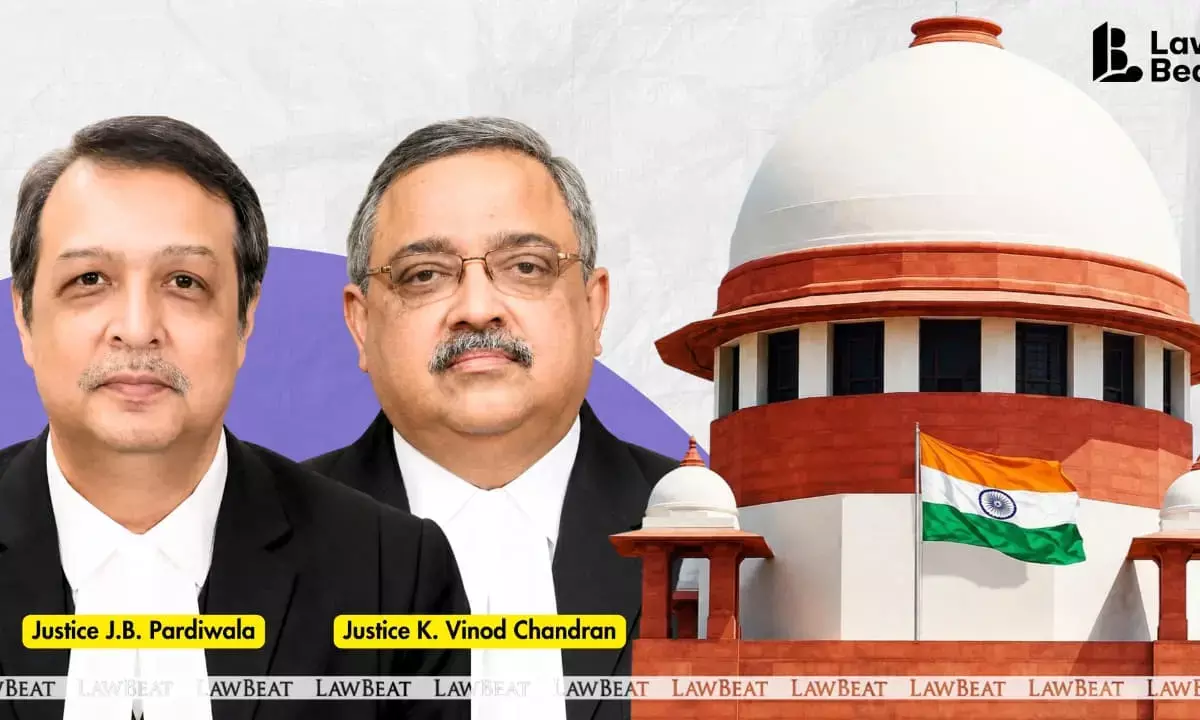
Supreme Court pulls up NCLAT over non-compliance.
The Supreme Court recently observed that when it makes a request to any court or tribunal, the request must be treated as a direction, and non-compliance with it would be viewed seriously.
A Bench of Justices J B Pardiwala and K Vinod Chandran made the observation while expressing strong disapproval of the National Company Law Appellate Tribunal (NCLAT) for not complying with the Supreme Court's July 15, 2026 order requesting it to hear and dispose of a matter by July 23.
Why did the Supreme Court pull up the NCLAT?
The case arose from an application filed by Sona Bansal. The Supreme Court had, in its July 15 order, made an earnest request to the NCLAT to hear the main matter on July 23, 2026.
The request was made in view of the fact that the National Company Law Tribunal (NCLT) had reserved its order on the application under Section 7 of the Insolvency and Bankruptcy Code, 2016.
During the hearing, counsel for Bansal informed the Bench that the NCLAT had still not heard the matter. In the meantime, the NCLT had pronounced its reserved order and admitted the Section 7 IBC application.
The Bench expressed its displeasure over the manner in which the matter had been handled by the NCLAT.
"We are quite disturbed with the manner in which the NCLAT has conducted itself in the present litigation. The request made is out of deference to their position and to ensure that the judicial office they hold is not belittled in any manner," the Bench said.
Supreme Court's 'request' is 'direction'
Court made it clear that the language of a Supreme Court order should not determine whether it is binding.
"When the Supreme Court makes a request to any Court or Tribunal, it has to be construed as a direction and not just a request," the Bench said.
Court explained that it may sometimes use polite and respectful language while addressing another court or tribunal. However, such language does not reduce the binding nature of the direction.
"It is one thing that the Supreme Court earnestly requests in the hope that the court or the Tribunal would abide by the request and do the needful. However, today, we make it very clear that if there is any request made by the Supreme Court to any court or Tribunal, the same shall be treated as a direction and non-compliance of such direction shall be looked into very seriously," the Bench said.
The Bench added, "Polite expression does not diminish authority, rather it enhances, which should never be understood as weakness."
Court also referred to an earlier instance in which a high court had failed to give precedence to a matter despite the Supreme Court directing the parties to approach it for expeditious consideration and indicating that the high court would give due attention to the request.
It relied on its 1994 judgment in Spencer and Co Ltd v Vishwadarshan Distributors Pvt Ltd, reported in 1995 SCC (1) 259. In that case, the Supreme Court had observed that when one superior constitutional authority speaks to another, the language used is often "sweet, soft and melodious", being more suggestive than directive.
Court had also held in that case that the language of request often used by the Supreme Court in such situations must be understood as an obligation, in keeping with the constitutional mandate and the requirement that all authorities act in aid of the Supreme Court.
Supreme Court sought explanation from NCLAT
The Bench was informed that the NCLAT had fixed the matter for November 17, 2026, despite the Supreme Court's earlier order.
The Supreme Court issued notice, returnable on November 19, 2026, and directed the NCLAT to explain why the matter had not been heard despite the specific direction issued by the Court.
"The NCLAT shall offer its explanation as to why the matter has not been heard till this date, despite our specific order," the Bench said.
In the meantime, the Supreme Court directed that there shall be no constitution of the Committee of Creditors.
Case Title: Sona Bansal Vs Vashisht Kumar Goel & Ors
Bench: Justices J B Pardiwala and K Vinod Chandran
Date of order: October 27, 2026