
What Happens When Property Sale Agreement Has Tampered Date? Supreme Court Explains in 1984 Dispute
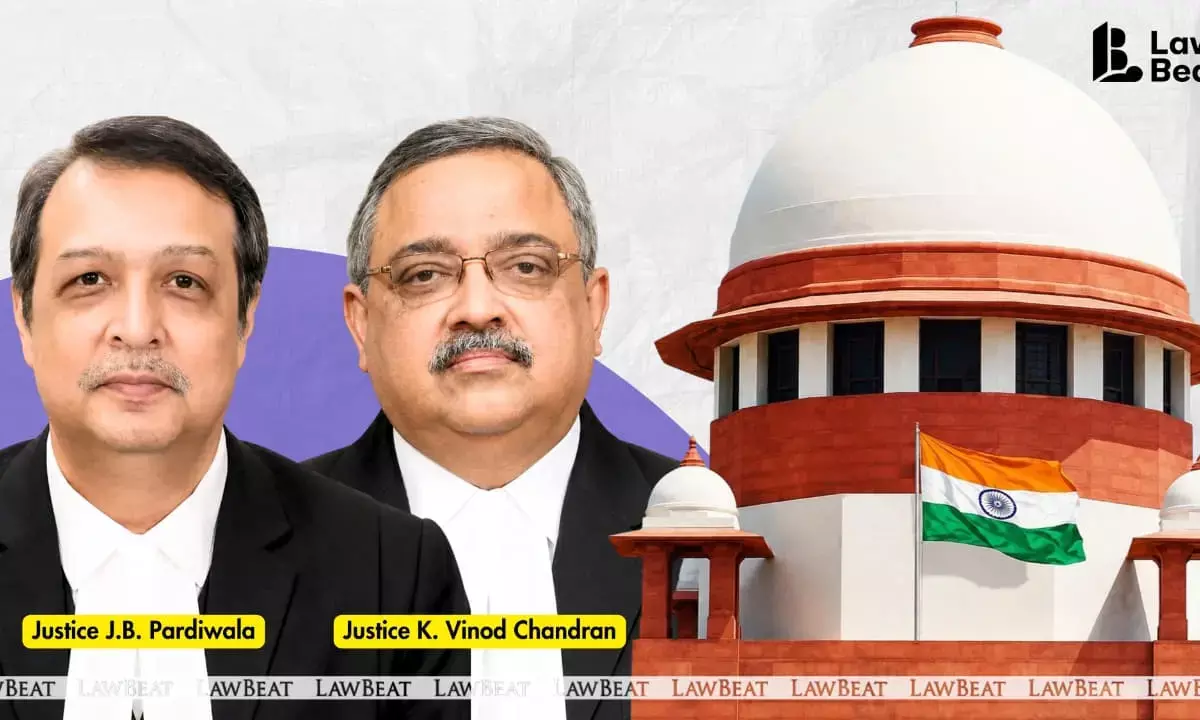
SC flags suspicious circumstances in 1984 property deal.
The Supreme Court recently set aside concurrent appellate rulings and restored the trial court's judgment dismissing a long-pending suit for specific performance arising from a 1984 property agreement.
A Bench of Justices J B Pardiwala and K Vinod Chandran held that the lower appellate courts had improperly brushed aside several suspicious circumstances identified by the trial court, including alleged tampering with the extended sale date, discrepancies regarding the purchase of the stamp paper and an admitted receipt for a substantial amount issued just before the expiry of the agreement.
Consequently, Court allowed the appeal and directed the defendants/appellants to refund the earnest money and balance consideration deposited by the plaintiffs, with simple interest at 12.5% per annum. It further ordered that a charge would be created on the property in case of default in payment.
What was the dispute over the 1984 property agreement?
The appeal was filed by Bohar Singh and another against a suit for specific performance filed by three respondents in 1987.
The suit was initially dismissed by the trial court. However, in first appeal, the dismissal was reversed and the suit was decreed. This decision was subsequently confirmed in second appeal, which was challenged before the Supreme Court.
The agreement was executed on August 16, 1984, for four acres of property at the rate of Rs 12,000 per acre. The plaintiffs paid Rs 27,300 as earnest money at the time of the agreement. The balance consideration was to be paid within two years.
The period for execution of the sale deed was later extended by one year, up to June 19, 1987, allegedly at the request of the defendant.
The defendant, however, denied having executed any such agreement and contended that the transaction was actually a loan transaction with the father of the plaintiffs.
The defendant also produced a receipt issued by the plaintiffs' father for Rs 27,875, the execution of which was admitted by the recipient.
What suspicious circumstances did the trial court find?
The trial court, in a reasoned judgment, found several discrepancies in the case set up by the plaintiffs.
It noted that the stamp paper on which the agreement was written had, as per the endorsement on it, been purchased on July 6, 1984, well before the agreement was allegedly executed on August 16, 1984.
The trial court also noted that although the agreement stated that possession had been handed over upon payment of earnest money, possession continued to remain with the defendant. This was also admitted by the plaintiffs.
The extension of the agreement from August 16, 1986 to June 19, 1987 was another circumstance that the trial court found suspicious, particularly because the extended date appeared to have been tampered with.
"The trial court rightly found that this explanation does not stand to reason, since what remained to be done by the defendant was mere execution and not arrangement of funds," the Bench said.
The Supreme Court further noted that there was nothing to show the plaintiffs' readiness or willingness to pay the balance consideration, particularly by establishing that they had the balance amount available with them.
Court also referred to the testimony of a witness who claimed to have gone to the Sub Registrar's Office on the agreed date with Rs 56,000. This amount was substantially higher than the balance consideration of only Rs 20,700.
Why did the Supreme Court restore the trial court's dismissal?
The Supreme Court said the first and second appellate courts had reversed the trial court's findings without properly dealing with the suspicious circumstances identified in its judgment.
"We cannot but emphasize the reasoning of the trial court which was reversed by the first appellate court and the second appellate court without application of mind," the Bench said.
Court observed that although the suspicious circumstances identified by the trial court had been referred to by the appellate courts, they had not been properly debunked before the burden of proof was shifted to the defendant.
The Supreme Court also found the reasoning concerning the alteration of the extended date unsatisfactory. The appellate courts had proceeded on a conjecture that one party may have disagreed with the date originally written, resulting in its correction. The Bench noted that there was no oral testimony supporting this explanation.
Court also placed significance on the receipt for Rs 27,875 issued by the plaintiffs' father on May 27, 1987, only a few days before the extended deadline of June 19, 1987.
"We cannot but observe that there was no good reason stated for the plaintiffs’ father to accept an amount which was a more than the balance sale consideration from the defendant," the Bench observed.
It noted that the sale could have been concluded by adjusting the amount paid by the defendant towards the balance sale consideration, particularly considering that the receipt was issued just before the extended deadline.
"On reckoning the various suspicious circumstances as pointed out by the trial court and the admission of execution of the receipt of Rs 27,875 just prior to the expiry date of agreement of 1984," the Bench said it was persuaded to restore the trial court's order.
What did the Supreme Court order regarding the money paid?
Court noted that Rs 27,300 had been paid as earnest money in 1984, as established by the evidence of one of the plaintiffs.
The plaintiffs had also deposited Rs 20,700, being the balance consideration, before the Treasury on January 29, 1994.
Considering the long lapse of time, the Supreme Court directed the defendants/appellants to repay the amounts paid and deposited by the plaintiffs/respondents with simple interest at the rate of 12.5% per annum.
The amount was to be repaid to the plaintiffs or deposited before the trial court for disbursal to them. Court further directed that a charge would be created on the property in the event of default in payment.
Case Title: Bohar Singh & Anr Vs Sardara Singh & Ors
Bench: Justices J B Pardiwala and K Vinod Chandran
Date of Judgment: August 31, 2026