
2008 Ahmedabad Serial Blasts: Supreme Court Stays Death Sentence Of Convict Mohammad Tanvir
Supreme Court has stayed the execution of the death sentence of an Indian Mujahideen operative involved in the 2008 Ahmedabad serial bomb blasts that left 56 people dead.
The Supreme Court has stayed the execution of the death sentence handed down to an Indian Mujahideen operative Mohammad Tanvir for his role in the 2008 Ahmedabad serial bomb blasts that left 56 people dead.
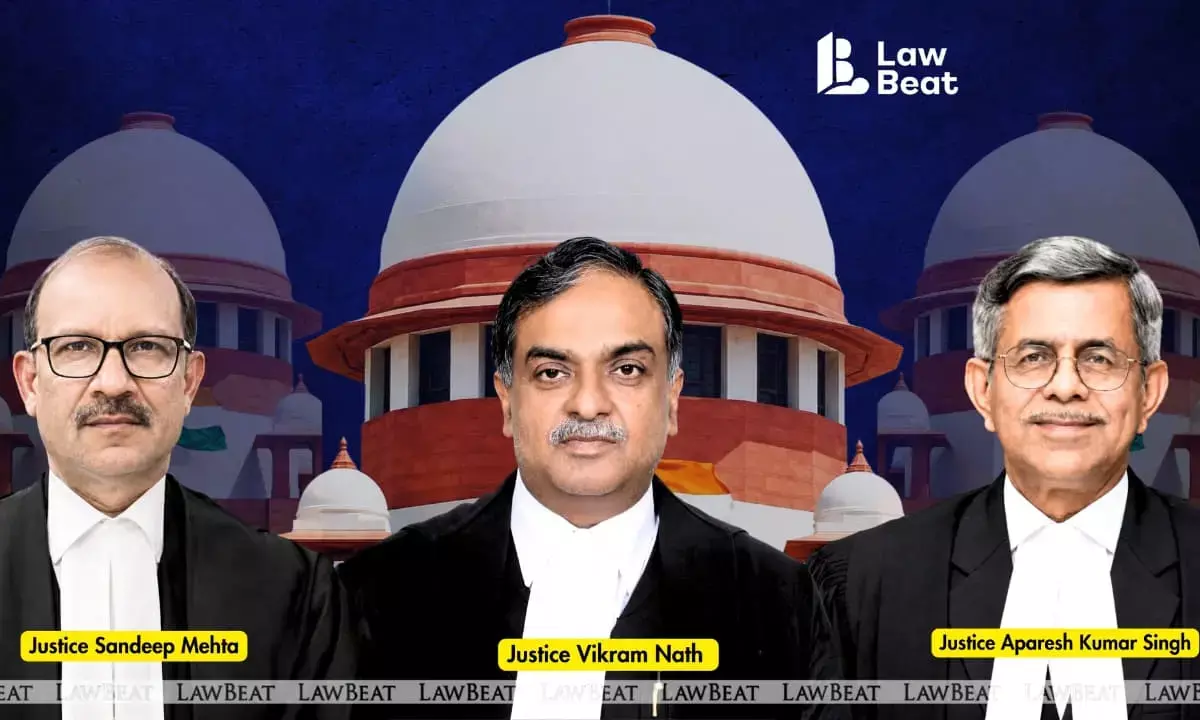
A bench of Justices Vikram Nath, Sandeep Mehta and Aparesh Kumar Singh agreed to hear a plea filed by Tanvir, who has challenged the Gujarat High Court's July 7 verdict.
"There shall be stay of execution of the death sentence awarded to the appellant. The original records of the case shall be summoned from the Trial Court and the High Court," the bench ordered on October 9, 2026.
Justice Nath led bench has also issued the following directions:
i. The State shall place before the Court the report(s) of all the Probation Officers relating to Tanvir within a period of eight weeks.
ii. The Superintendent of Prison of the concerned prison, shall submit a report with regard to the nature of work which has been performed by Tanvir while in jail and a report with regard to his conduct and behaviour while in jail, within a period of eight weeks.
iii. The Superintendent of Prison of the concerned prison, shall also get done Tanvir's psychological evaluation from the Government Medical Hospital.The report of the evaluation shall be submitted to the Court through the Standing Counsel for the State of Gujarat within a period of eight weeks.
The matter will now be taken up after 12 weeks.
On July 7, 2026 the Gujarat High Court upheld a 2022 Special Court order sentencing 38 convicts to death and 11 others to life imprisonment in the 2008 Ahmedabad serial blasts case, which had claimed 56 lives.
On July 26, 2008, 22 bombs exploded across Ahmedabad, including at the Civil Hospital, LG Hospital, buses, parked bicycles and cars, killing 56 people and injuring around 200. Police alleged that the serial blasts were carried out by members of Indian Mujahideen (IM), linked to the banned Students Islamic Movement of India (SIMI), to avenge the 2002 post-Godhra riots.
What did the Gujarat High Court hold?
In an exhaustive 2,223-page judgment confirming the death penalty for 38 convicts and life imprisonment for 11 others, the Gujarat High Court had observed that the 2008 Ahmedabad Blasts were a calculated act of revenge, where it was "not a coincidence that the victims were Hindu".
The Division Bench, comprising Justice A.Y. Kogje and Justice Samir J. Dave, ruled that the sequence of events provides an extensive mapping of how structural radicalisation, forensic engineering, and calculated logistical choices were combined to wage a targeted war against India's sovereignty.
The high court upheld the convictions under stringent provisions of the Unlawful Activities (Prevention) Act (UAPA), the Indian Penal Code (IPC), including Section 302 (murder), and 120B (criminal conspiracy), and the Explosive Substances Act. The Court traced the origins of the serial blasts to a synchronised series of inter-state terror training camps and secret organisational meetings found to be orchestrated under the banner of the banned organisation, Students Islamic Movement of India (SIMI).
The division bench noted that the conspirators consciously chose not to restrict the explosions to busy marketplaces; instead, they targeted the emergency healthcare infrastructure of the state so as to "enhance the impact" of the entire operation. The bench highlighted that the cells operating in Mumbai stole cars, altered their registration plates to mislead investigators, and drove them into Gujarat.
The bench remarked: "The timing of the explosion at Government Hospital almost coincided with the time of arrival of injured persons from other blasts being brought to the Hospital in ambulances and, in fact, the explosion took place as planned, thereby affecting treatment facilities available to the injured of the other blasts which had occurred in other parts of the city".
The High Court placed immense reliance on scientific data to establish the presence of a singular macro-conspiracy. While Ahmedabad witnessed devastating explosions, 15 high-intensity devices planted across Surat were recovered unexploded between July 27 and August 9, 2008.
The Court highlighted an undeniable structural uniformity in bomb engineering across multiple states, such as the Jaipur Blasts (May 2008), Surat Planting (July 2008), Ahmedabad Blasts (July 2008), and Delhi Blasts (Sept 2008).
The State was ordered to pay compensation to the family of deceased and injured victims to the tune of Rs.10 lakhs for each deceased, Rs.5 lakhs for grievous hurt or permanent deformity/disability, Rs.1 lakh for simple injury.
Trial Court's decision
In February 2022, a Special Court in Ahmedabad had sentenced 38 of the 49 convicts to death under provisions of the Unlawful Activities (Prevention) Act (UAPA) and Section 302 of the Indian Penal Code. The 11 others were sentenced to life in jail till death. Special Judge A. R. Patel had awarded Rs 1 lakh as compensation to the kin of each person killed in the blasts, Rs 50,000 for each victim with serious injuries, and Rs 25,000 each for those with minor ones
Case Title: MOHD. TANVIR @ TALHA MOHD. AKHTAR PATHAN VERSUS STATE OF GUJARAT
Bench: Justices Nath, Mehta and Singh
Order Date: October 9, 2026