
Bhojshala Dispute: Supreme Court Allows Friday Namaz Be Offered At Adjacent Dargah Land
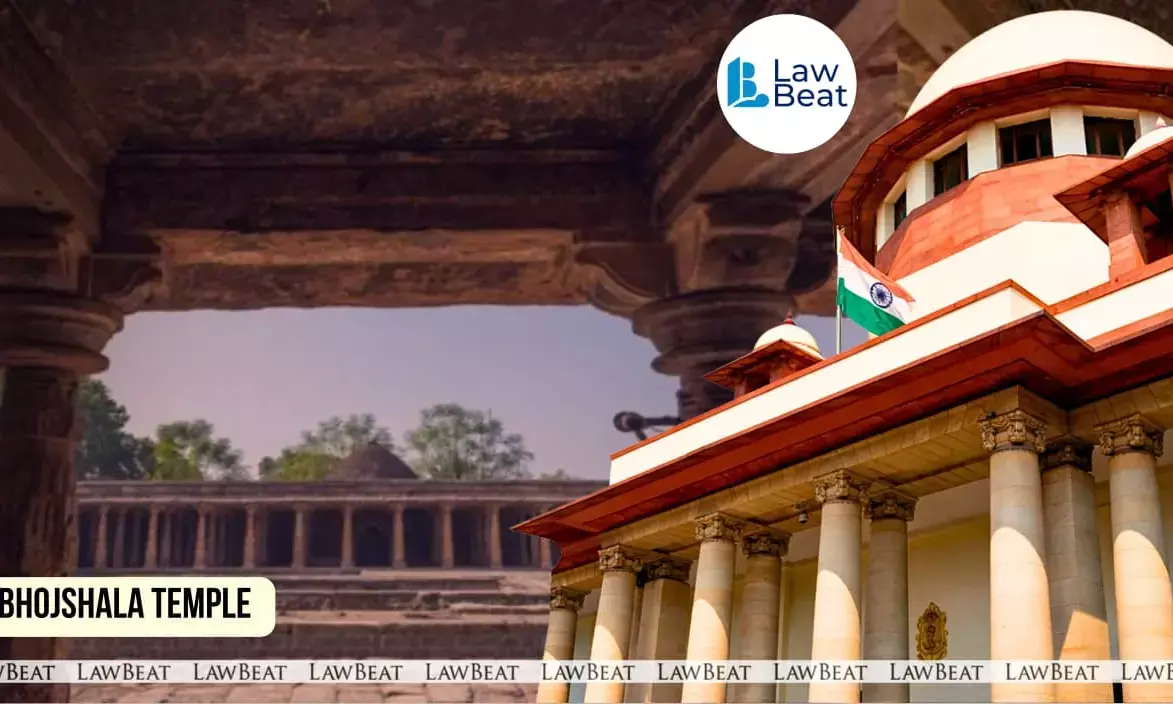
Plea before Supreme Court Challenges MP High Court Verdict in Bhojshala Dipsute.
The Supreme Court today has ordered that Friday namaz can be offered near the disputed Bhojshala- Kamal Maula Mosque complex in Madhya Pradesh's Dhar, on an adjacent dargah land with a separate access road.
A CJI Surya Kant's bench has ordered thus after Muslim side had informed court the alternate site offered to them for conducting namaz is far away. This was after Court had directed that an alternate site be provided by the Madhya Pradesh government for offering of namaz.
Senior Advocate Huzefa Ahmadi told the bench today that multiple waqf properties adjoining the disputed site were available. He further told court that fears of protests could not become the basis for restricting religious freedoms.
A Bench comprising Chief Justice of India Surya Kant and Justices Joymalya Bagchi and V. Mohan accepted one of the sites shown to it noting it had independent access road, making it suitable for Friday prayers without requiring entry into the disputed premises. The court directed the State government to ensure necessary arrangements are made for namaz every Friday between 1 pm and 3 pm.
During the hearing, ASG KM Nataraj, appearing for the Madhya Pradesh government maintained that its primary concern was maintaining peace and public order and it did not want to enter into the competing claims of the two parties.
The Supreme Court had recently heard petitions filed by over the Bhojshala-Kamal Maula Mosque complex in Madhya Pradesh's Dhar wherein the Muslim side challenged a Madhya Pradesh High Court verdict declaring that the religious character of the disputed Bhojshala-Kamal Maula Mosque complex is that of Bhojshala, a temple dedicated to Goddess Vagdevi Saraswati, and directed the Archaeological Survey of India to continue supervising and managing the protected monument under the Ancient Monuments and Archaeological Sites and Remains Act, 1958.
While refusing to stay the impugned order, a CJI Surya Kant led bench also refused a prayer made by the Muslim side to offer namaz at the site on Fridays. Court has in fact directed that an alternate site be provided by the Madhya Pradesh government for the same. Issuing notice on the pleas, the bench also comprising Justices Bagchi and Mohana ordered that the matter will be listed for final hearing and pleadings be completed in the meantime.
The SLP before Supreme Court has been filed by Qazi Moinuddin, mosque's caretaker and one of the intervenors in the case, against the May 15 judgment delivered by the Indore bench of the Madhya Pradesh High Court.
Indore Bench of Justice Vijay Kumar Shukla and Justice Alok Awasthi had allowed petitions filed by Hindu Front for Justice and others, holding that the continuity of Hindu worship at the site had never been extinguished. The court also set aside portions of the April 7, 2003 ASI order that restricted Hindu worship within the complex while permitting namaz by the Muslim community on Fridays.
The Bench observed that archaeological interpretation necessarily involved multidisciplinary and transdisciplinary approaches and that courts could safely rely upon conclusions derived through scientific archaeological studies undertaken by the ASI.Referring to the constitutional framework under Articles 25 and 26, the court held that governments carry an obligation to preserve monuments, temples, deities and sanctum sanctorum of archaeological and historical importance while also ensuring law and order and maintaining the pristine character of such places.
“We have noted the continuity of Hindu worship at the site through regulated practices over time has never been extinguished,” the court said while recording findings that historical literature established Bhojshala as a centre of Sanskrit learning associated with Raja Bhoj of the Paramar dynasty. The Bench further held that literary and architectural references indicated the existence of a temple dedicated to Goddess Saraswati at Dhar.
The court ruled that the disputed Bhojshala-Kamal Maula Mosque complex is a protected monument under the 1958 Act with effect from 18.03.1904 and held that its religious character is that of Bhojshala containing a temple of Goddess Vagdevi Saraswati. It further directed the Union government and ASI to take decisions regarding administration and management of Bhojshala temple and Sanskrit learning activities within the disputed property, while clarifying that ASI would continue exercising overall supervisory control over preservation and conservation.
The Bench also addressed claims concerning the Saraswati idol believed to be housed in a London museum. Recording that representations had already been submitted by certain petitioners seeking return of the idol, the court directed the Union government to consider those representations for bringing back the idol and reinstalling it within the Bhojshala complex.
At the same time, the High Court sought to balance competing religious interests by safeguarding rights of the Muslim community. The court observed that if respondent parties representing the Muslim side submit an application seeking allotment of suitable land for construction of a mosque or prayer space within Dhar district, the state government shall consider such a request in accordance with law and facilitate allotment of suitable permanent land for a mosque and related facilities.