
Delhi Rape Incidents: Supreme Court Issues Fresh Directions On Cab Driver Checks, SOS Buttons And Illegal Liquor Shops
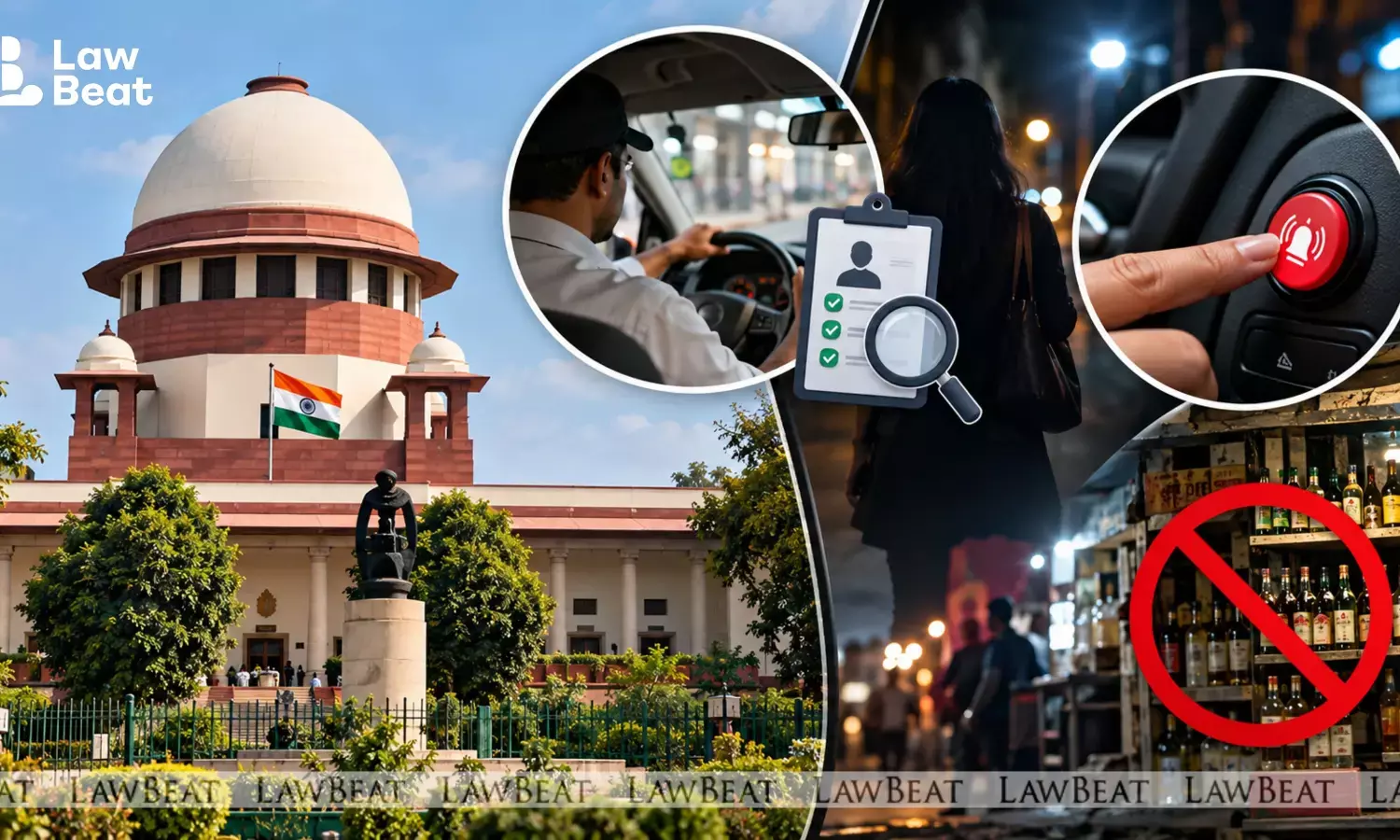
Supreme Court directed the Delhi Police and the Delhi Government to report on control-room "war rooms", driver verification in public transport and the functioning of the Shishtachar Squads
The Supreme Court on October 5 invoked the "Broken Windows" theory of policing while hearing the suo motu case it initiated over recent incidents of rape in Delhi NCR, and observed that a broken streetlight, a non-functional CCTV camera or an unattended complaint, though minor in isolation, together convey that public spaces are not being watched.
The bench of Justice JB Pardiwala and Justice K Vinod Chandran was hearing In Re: Recent Rape Incidents in Delhi NCR, which the Court took up on September 28. This was the first hearing after cognisance was taken.
Referring to the theory propounded by Prof. James Q. Wilson and George L. Kelling, the Bench noted that visible civic neglect may lead citizens to withdraw from public spaces, "which in turn would provide a safe haven for undesirables, anti-socials and depraved minds, to whom an unsuspecting citizen, who unknowingly steps in, will fall prey to."
"Applied to the present context, a broken or inadequate streetlight, a non-functional CCTV camera, an unmonitored dark stretch, or an unaddressed public complaint may individually appear as minor administrative or infrastructural lapses. However, when such deficiencies remain visible and unattended over a period of time, they collectively convey a perception of neglect and diminished vigilance," the Court said.
The Bench added that "Public safety, therefore, cannot be viewed solely through the prism of a response to a crime after it has occurred," and that "Deficiencies which are capable of being identified and remedied ought not to be left unattended until they manifest themselves in an actual incident of crime."
Senior Advocate Liz Mathew, appearing as Amicus Curiae, pressed for enhanced beat patrolling across Delhi. She placed before the Court Delhi Police Circular, dated March 8, 2025, which set up district-wise anti-eve teasing squads called Shishtachar Squads, and Standing Order titled "Action Against Sexual Offences in Public". She also cited Report of the Comptroller and Auditor General of India, which flagged a shortage of around 39% in police staff on active duties such as beat patrol and investigation.
She further pointed out that at least eight separate portals and helplines exist for grievances over lighting, CCTV coverage and similar concerns, and that this multiplicity confuses lay persons, many of whom lack smartphones or digital literacy. The Amicus suggested QR codes for police patrolling with automated time-stamping and geo-mapping or geo-fencing to secure accountability.
Solicitor General Tushar Mehta, assisted by ASG Archana Pathak Dave, told the Court that officials of the Delhi Government, Delhi Police, DDA, MCD, NDMC and the Ministry of Women and Child Development had begun joint deliberations to comply with the interim directions of September 28.
The Bench clarified it was not building a new framework. "The purpose of the present proceedings and the directions issued herein is not to multiply protocols or to create another layer of administrative compliance. Rather, it is to ascertain whether the mechanisms already devised by the police are operating as living instruments of preventive policing or have those remained substantially confined to the realm of mere paperwork," the order reads.
"Ultimately, the efficacy of a preventive policing framework must be judged not by the number of Standing Orders issued, but by the extent to which those orders translate into visible police presence, timely intervention, deterrence and a demonstrable sense of safety amongst citizens," the Court observed, adding that "the recurrence of such incidents, despite the existence of the aforesaid protocols, raises a serious concern as to whether the existing directions are being implemented with the degree of consistency, supervision and accountability contemplated."
"War rooms" and citizen engagement
Stressing real-time monitoring of patrolling and CCTV networks through control-room command centres or "war rooms", the Bench said, "The information gathered through these control room command centres must feed into an effective field-level response mechanism, so as to facilitate timely deployment or intervention, as soon as a vulnerability, incident or deficiency requiring attention is detected."
The Commissioner of Police and the Chief Secretary have been directed to jointly report whether such centres exist in Delhi, how many there are, the areas they cover, and the protocols for real-time coordination and emergency deployment.
The Court also asked the police and local administration to consider regular citizen-engagement meetings under a designated officer, with particular focus on areas around educational institutions and paying-guest accommodations housing young women and girls. "Such citizen-centric mechanisms must inspire confidence amongst the public that the information furnished by them will be received sensitively, acted upon promptly, and where appropriate, kept confidential," it said.
On training, the Bench held that "Preventive policing must, however, become an institutional practice and not remain dependent upon individual initiative," and directed that it form part of induction and periodic training.
Immediate directions
-In addition to its earlier directions, the Court ordered the Delhi Police, the local administration and the Transport Department of GNCTD to immediately:
-Enhance beat patrolling across Delhi, particularly around schools, colleges, universities, coaching institutions and zones flagged in the vulnerability mapping exercise.
-Strictly verify drivers and assistants of government and private buses, app-based cabs and rickshaws on platforms such as Ola, Uber and Rapido, and privately operated cabs, taxis and auto-rickshaws. "Only duly registered and verified persons shall be permitted to operate such vehicles. All such vehicles shall display, in an area visible to the passenger, the names and photographs of the verified driver(s) and assistant(s) associated with such vehicle so that the passenger may immediately identify and report when unauthorised persons are involved," the Court directed. The Road Transport Officer of each jurisdiction will be responsible for ensuring the display, and "unauthorised sub-letting to an unverified driver must be prohibited."
-Act promptly on violations, which "must invite prompt regulatory action, including but not limited to suspension/dismissal from service of the driver/assistant and seizure of the concerned vehicle, as the case may be, with immediate effect."
-Examine implementation of the Court's May 13, 2026 directions on Vehicle Tracking System Devices in S. Rajaseekaran v. Union of India and their integration with the police emergency response system.
-Run awareness drives on SOS mechanisms in vehicles, and place on record the response protocol, the unit responsible and the prescribed turnaround time.
-Remove trucks and heavy vehicles habitually parked where they obstruct visibility, create blind spots or harbour unauthorised persons.
-Act against unauthorised liquor shops and eateries serving liquor unlawfully. Beat officers "shall ensure that any loitering, crowding or assembly of persons around liquor shops is promptly dispersed, to prevent harassment and ensure unhindered safe movement for pedestrians."
Shishtachar Squads under scrutiny
The Commissioner of Police has been directed to place on record the weekly diaries of the Shishtachar Squads for the preceding three months, along with a consolidated analysis, so the Court can ascertain "not merely whether the Shishtachar Squads exist administratively, but the extent to which they have been operational."
The Commissioner must also file a status report on Operation "Nirbheek" and the "Nazuk" Scheme, which encourage school and college-going girls to report sexual offences, setting out how complainants' identity and confidentiality are protected and how retaliation is prevented. The Research and Development Branch of the Delhi Police has been asked to assess the squads' training modules and examine whether gaps in training or supervision contributed to "the apparent gap between the safeguards contemplated on paper and their perceived effectiveness on the ground."
Caution against excess
The Bench, however, cautioned that "the pursuit of preventive policing cannot become a justification for arbitrary or excessive or disproportionate exercise of police powers." It added, "A system which seeks to inspire confidence in citizens must necessarily be one in which citizens are protected not only from crime, but equally from unlawful or disproportionate exercise of State power."
Officers made answerable
The authorities must file a consolidated, district-wise status report on or before November 6, 2026. The Chief Secretary and the Commissioner of Police will be the deponents of all affidavits for the Administration and the Police respectively. "If at any stage, we find that our directions are not being complied with, implemented or accorded the seriousness which is warranted, these two officers shall be made personally answerable," the Court warned.
While carrying out the lighting audit, authorities have been directed to assess adequacy independently of illumination from billboards and private buildings, and to address the Amicus's concerns over multiple grievance portals.
The Registrar General of the Delhi High Court has also been directed to furnish the information sought in the earlier order by November 6. Joint Commissioners of Police Vijay Kumar (Southern Range), Madhur Verma (Central Range) and Surender Kumar (Crime), who were present in Court, have been asked to appear again on the next date.
The Court issued notice to the Ministry of Home Affairs and the Transport Department of the Delhi Government, treated the matter as part-heard, and listed it on November 16, 2026.