
‘Don’t Spoil A Good Case’: SC Tells Ashwini Upadhyay In PIL Seeking Regulation Of All Religious Schools For Children Below 14
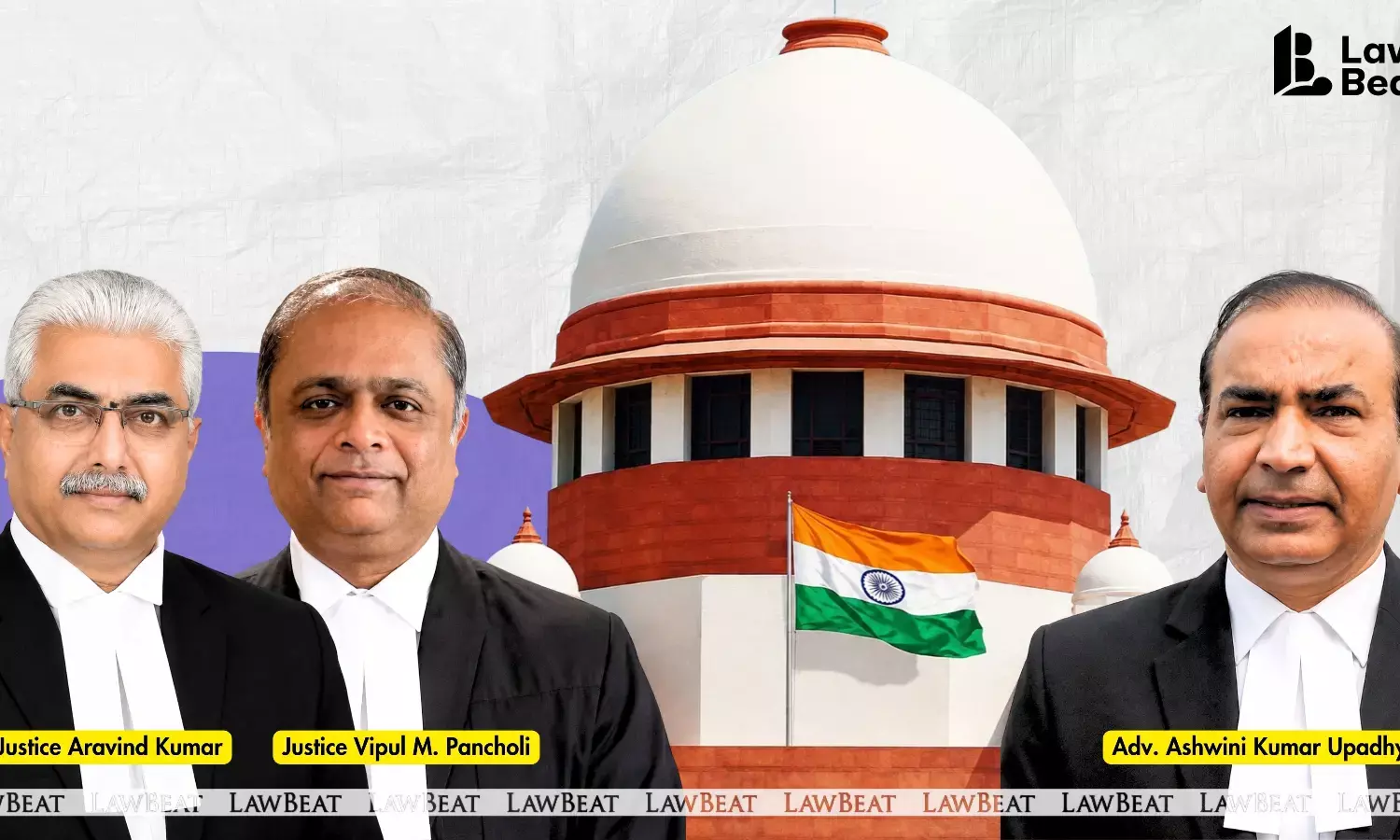
Supreme Court advised Ashwini Upadhyay to pursue contempt proceedings instead of filing a fresh PIL
The Supreme Court on Monday advised Advocate Ashwini Upadhyay, appearing in person in a PIL seeking registration, recognition, supervision and monitoring of institutions imparting secular or religious education to children up to 14 years, to pursue contempt proceedings instead of filing a fresh writ petition.
The Bench of Justice Aravind Kumar and Justice Vipul M. Pancholi was hearing Upadhyay's plea concerning regulation of institutions imparting education to children, including issues concerning minority institutions and the applicability of the Teachers Eligibility Test (TET).
Justice Aravind Kumar pointed out that Upadhyay had earlier approached the Supreme Court and obtained an order directing the authorities to consider his representation within two months.
“You approached this Court earlier. The Court issued a writ of mandamus directing the authorities to consider your representation within two months,” the Court observed.
Upadhyay submitted that despite the direction, the authorities had not considered his representation even after three months.
Justice Kumar then asked what remedy remained available to him.
When Upadhyay said that he had filed the present writ petition, the Bench cautioned that the fresh petition would not be maintainable.
“It will not be maintainable for more than a minute. The third writ petition will be dismissed in limine,” Justice Kumar remarked.
The Bench advised Upadhyay to file a contempt petition alleging non-compliance with the earlier Supreme Court direction.
“The remedy is simple. Go and file a contempt petition. We will entertain it,” Justice Kumar said.
Upadhyay, however, attempted to explain the larger legal issues raised in his PIL, including the interplay between Articles 26 and 30 of the Constitution and the applicability of TET requirements to minority educational institutions.
The Bench made it clear that those issues were not relevant to the maintainability of the present petition.
“That issue has nothing to do with your present matter. Your writ is already in your favour,” Justice Kumar observed.
The judge further said that the Court had already passed an order protecting Upadhyay's position and that the appropriate course was to seek enforcement of that order.
“We have already got an order enforcing your right. How to enforce it? File contempt. Do whatever you want,” the Court said.
The Bench also cautioned Upadhyay against taking a course that could undermine the relief he had already secured.
“You should never hit a self-goal,” Justice Kumar said.
The Court further remarked, “Don’t spoil a good case by your own…”
Justice Kumar added that the advice was being offered in the Bench's capacity as members of the Supreme Court Legal Services Committee.
“We are giving you free advice, in our capacity as members of the Supreme Court Legal Services Committee,” he said.
Upadhyay eventually sought permission to withdraw the petition.
The Court permitted the withdrawal with liberty to take appropriate steps.
“With liberty to withdraw the petition. Take appropriate steps,” the Court ordered.
Even after the withdrawal was indicated, Upadhyay pressed the larger issue concerning minority institutions and religious instruction.
The Bench, however, advised him to raise the issue in appropriate proceedings.
“Use it when and where the appropriate battle,” Justice Kumar said, before concluding with, “Best of luck.”
About the PIL
The petition, filed under Article 32 of the Constitution by Advocate Ashwini Kumar Upadhyay, also seeks a declaration that Article 30 of the Constitution protects only minority institutions imparting secular or professional education and does not extend to institutions providing religious instruction.
According to the plea, the State has a constitutional obligation under Article 21A, read with Articles 14, 15, 16, 39(f), 45 and 51A(k), to ensure that every institution educating children below 14 years functions within a statutory regulatory framework through registration, recognition and regular supervision.
The petitioner alleged that during visits to several border districts of Uttar Pradesh earlier this year, he found numerous institutions functioning without registration or recognition. The plea further claims that similar institutions have proliferated in border districts across the country, contending that the absence of regulatory oversight adversely affects children's right to quality education and raises concerns regarding their welfare and safety.
The PIL argues that institutions imparting religious instruction should constitutionally fall within the ambit of Article 26, which governs religious and charitable institutions, rather than Article 30, which protects the educational rights of minorities.
It further seeks a declaration that Article 30 is merely a specific reiteration of the right under Article 19(1)(g) to establish educational institutions and does not confer any additional rights or privileges beyond those available to other citizens.
The petitioner has also urged the Court to interpret the phrase "educational institutions of their choice" under Article 30 as referring only to secular or professional educational institutions, contending that institutions primarily imparting religious instruction ought to be governed by Article 26.
Additionally, the PIL questions the absence of a statutory definition of the term "minority" and seeks directions to the Union Government to define the expression and prescribe objective criteria for identifying minority communities. Alternatively, it requests the Supreme Court to frame appropriate guidelines for such identification.
Relying on constitutional provisions, Constituent Assembly Debates and previous Supreme Court judgments, the petition argues that Articles 25 to 28 constitute a complete constitutional code governing religious freedom, while Articles 29 and 30 are intended exclusively to protect the cultural and educational rights of minorities.
In its prayers, the PIL seeks directions to the Centre and States to regulate all institutions imparting education or religious instruction to children below 14 years of age. It also seeks declarations that Article 30 is a reiteration of Article 19(1)(g), that institutions imparting religious instruction fall under Article 26 rather than Articles 19 or 30, and that Article 30 protects only minority institutions imparting secular or professional education.
Case Title: Ashwini Kumar Upadhyay v. Union of India & Ors.
Bench: Justices Aravind Kumar and Vipul M. Pancholi
Hearing Date: August 10, 2026