
Independent Judge Doesn’t Mean One Who Always Fights The Executive: Solicitor General Tushar Mehta
AI Can Be a Backup in Law, Not the Only Mode, Says SG Tushar Mehta
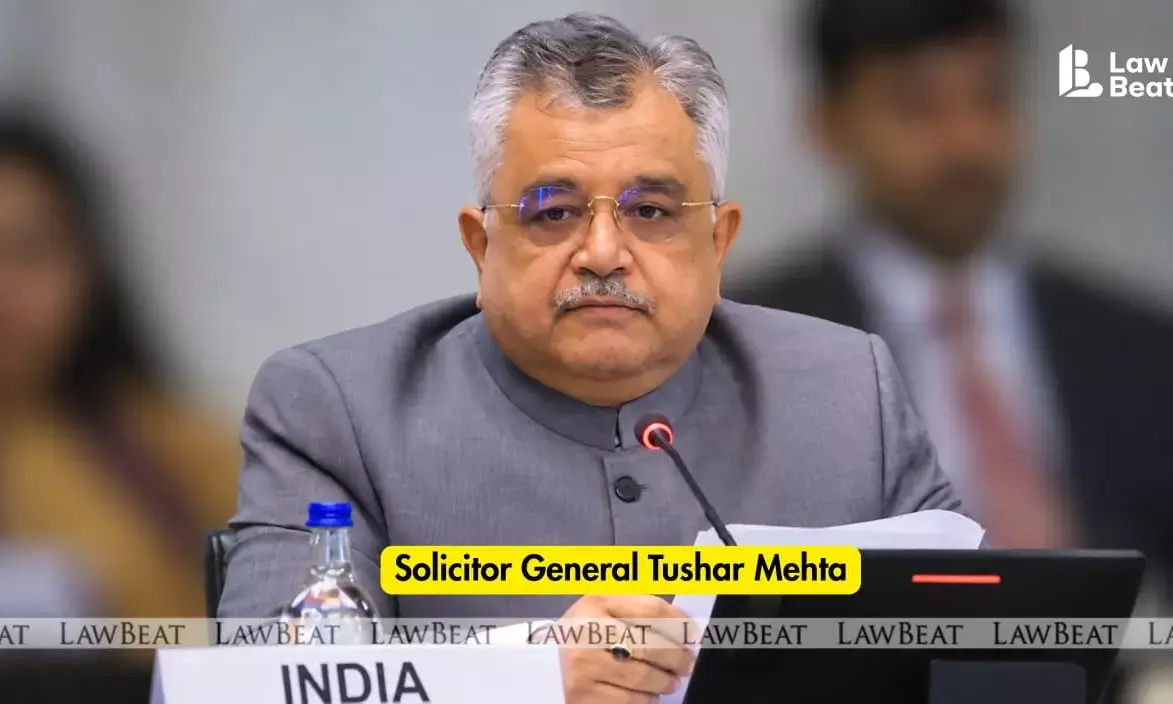
Solicitor General of India Tushar Mehta has said that courts must not take over the role of the executive in framing policy. He added that an independent judge is not one who “always fights with the executive”.
Speaking at an event “Shaping the Legal Architecture of Viksit Bharat: The Supreme Court and India @ 2047”, Mehta covered contract law reform, the limits of judicial intervention and the role of artificial intelligence in the justice system. He stressed that his views on the judiciary were “personal” and not those of a government representative.
Responding to a question on whether the Indian Contract Act needs an overhaul to give investors more certainty, Mehta said India’s aim had changed. Earlier, the goal was to become a developing country. Now, he said, “we are no longer in the race for being a developing country. We are in the race for being a developed country.”
He cited figures he had come across on India’s digital payments, saying the country’s footprint is double that of China and 2.5 times that of the United States. He also noted that India adds a new internet or mobile subscriber every second.
On the Contract Act, Mehta conceded that it “may need a little tweaking” given the disputes of the modern day. “Contract Act also needs to be re-examined and reloaded,” he said. He pointed to the recent overhaul of criminal laws as an example. Critics had objected to the renumbering of sections, but he explained the government’s reasoning. The Indian Penal Code was drafted from a British point of view, he said, which is why sedition sat at Section 124 while rape was at Section 376. “Now we have priorities,” he said.
Mehta added that reform need not wait for legislation. He referred to Lord Denning, who in the 1950s recognised that contracts can be struck between parties who cannot negotiate as equals, such as an insurance company and the insured. Even where consent is presumed, Mehta said, a term can be challenged. “The judiciary can play a role in terms of interpreting the law which would suit the modern day contract making,” he said.
The sharpest remarks came on the role of courts. Mehta said India has an "absolutely independent judiciary", but argued that independence has been wrongly defined. Some people define independence to mean constant conflict of judiciary with either executive or legislature.“Independent judge does not mean that a judge who always fights with the executive,” he said, adding that the executive is not a political party but represents every citizen and answers to every citizen.
According to Mehta, the people have elected a government to frame economic, financial and technology policy. The judiciary can and should intervene when fundamental rights are violated, he said, but it “cannot substitute being an executive”. He called what he sees as the problem “NGO activism” and said, “I’m criticized for calling it” that. It is “not permissible in judiciary”, he said, unless a violation of fundamental rights is shown.
Mehta said the tendency comes from a “bona fide temptation”, not bad intention, as judges may believe another policy is better for the nation. But he asked whether they can impose it on “140 crore Indians who have not voted them to do that”. He described the statement as “party neutral”. He also said some environmental law judgments in the last decade “took India back by at least one and a half to two decades”.
On innovation, he said it belongs to the other branches. “Innovation is not something which is given to judiciary. Innovation is given to executive and even the legislature,” he said. They “can also experiment”, he added, and such experiments can be tested by a Constitution Bench. “You cannot ignore it,” he said.
Asked whether AI could cut the burden of nearly 4.5 crore pending cases, including tax disputes, Mehta said he was not sceptical of AI but called its use in law “a little distant dream”. A machine, he said, cannot replace human emotion in deciding a case.
He shared two examples. The first was a US traffic system said to have charged Black women more heavily, which he said was traced to the prejudice of its creator. The second was a New Zealand case in which a judge suspected a written apology was AI-generated. That raises the question, Mehta said, of how a court can judge whether an apology comes “from the heart”.
He noted that the Supreme Court of England has had to lay down guidelines and that fake case citations are surfacing. AI, he said, can serve the “logistical aspects of law” as “a backup, not as the only mode”.
Closing on an optimistic note, Mehta said India has the risk-taking businessmen and the manpower it needs. “The only thing we have to ensure is right direction and less of interruption in the process,” he said.
Event Name: Shaping the Legal Architecture of Viksit Bharat: The Supreme Court and India @ 2047
Event Date: November 5, 2026