
'Not A Coincidence Victims Were Hindu': Why Gujarat HC Upheld Death Penalties In Revenge-Driven 2008 Ahmedabad Blasts
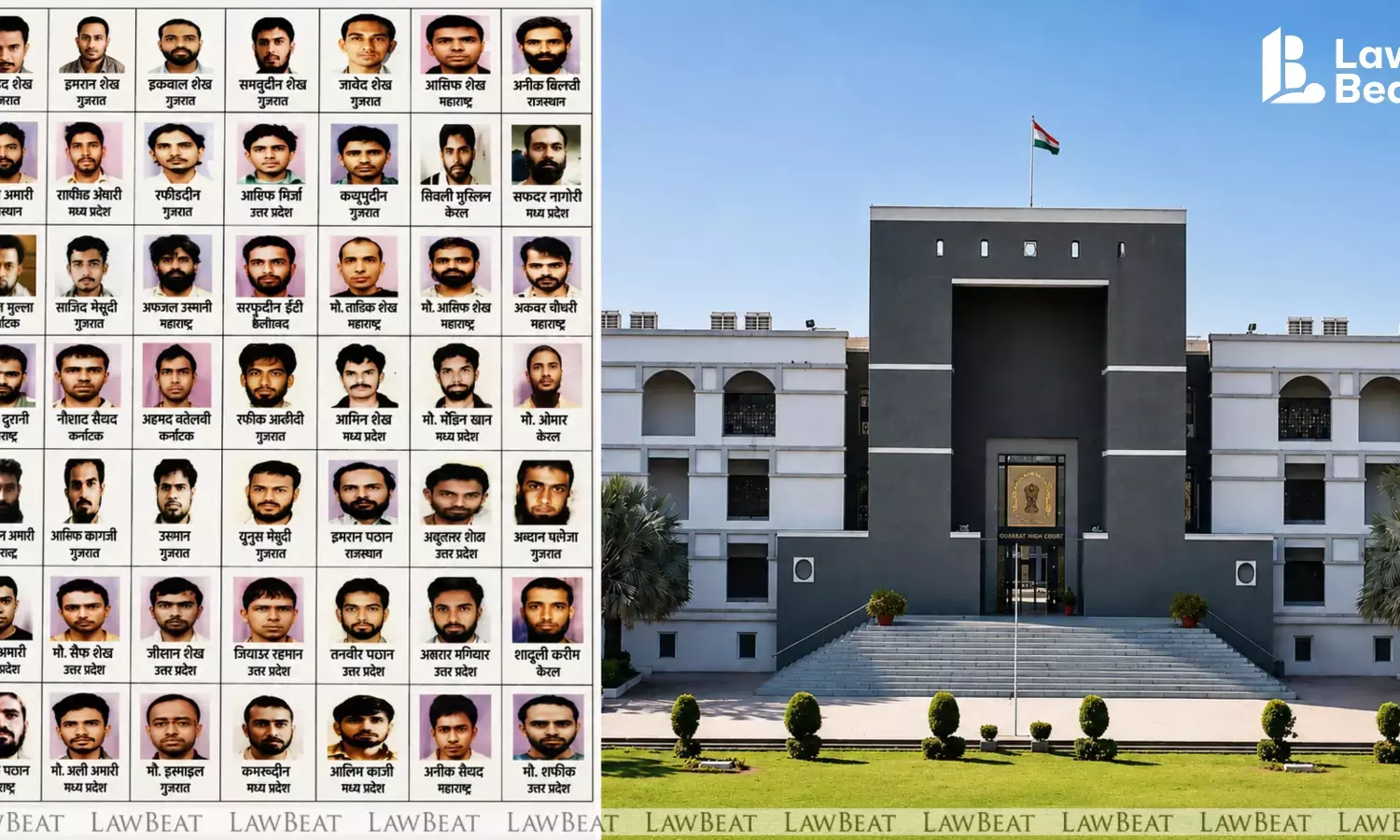
Gujarat HC said that the 2008 Ahmedabad serial blasts were part of a pan-India terror conspiracy orchestrated by banned outfit SIMI and targeted civilians in a revenge-driven attack.
In an exhaustive 2,223-page judgment confirming the death penalty for 38 convicts and life imprisonment for 11 others, the Gujarat High Court observed that the 2008 Ahmedabad Blasts were a calculated act of revenge, where it was "not a coincidence that the victims were Hindu".
The Division Bench, comprising Justice A.Y. Kogje and Justice Samir J. Dave, ruled that the sequence of events provides an extensive mapping of how structural radicalisation, forensic engineering, and calculated logistical choices were combined to wage a targeted war against India's sovereignty.
The court upheld the convictions under stringent provisions of the Unlawful Activities (Prevention) Act (UAPA), the Indian Penal Code (IPC), including Section 302 (murder), and 120B (criminal conspiracy), and the Explosive Substances Act.
The Pan-India operational blueprint
The Court traced the origins of the serial blasts to a synchronised series of inter-state terror training camps and secret organisational meetings found to be orchestrated under the banner of the banned organisation, Students Islamic Movement of India (SIMI).
• The Vagamon Camp (December 2007): Held in the isolated forests of Vagamon, Kerala, where select cells from Madhya Pradesh, Uttar Pradesh, Maharashtra, Karnataka, and Gujarat gathered. The Court recorded that convicts were imparted physical and weapon training, alongside intense debates designed to indoctrinate attendees into launching mass-casualty operations.
• The Pavagadh Camp (January 2008): Orchestrated in the deep forest areas of Halol, Gujarat. The judgment noted that this camp acted as the immediate operational precursor, focusing specifically on tactical bomb-making methodologies and physical fitness routines.
• The Inter-State Grid: The Court observed that the logistics required convicts to travel seamlessly via private and public transport, staying at meticulously selected, highly isolated spots to evade local intelligence nets.
Calculated Brutality: Targeting of Hospital Trauma Centres
Detailing the severity of the target execution scheme of the accused, the High Court weighed the perpetrators' intent heavily while upholding the capital punishment.
The division bench noted that the conspirators consciously chose not to restrict the explosions to busy marketplaces; instead, they targeted the emergency healthcare infrastructure of the state so as to "enhance the impact" of the entire operation.
The bench highlighted that the cells operating in Mumbai stole cars, altered their registration plates to mislead investigators, and drove them into Gujarat.
According to the forensic evidence evaluated by the bench, these vehicles were packed with lethal concentrations of ammonium nitrate, secondary shrapnel projectiles (nails, ball bearings, nuts, and bolts), and highly flammable LPG cylinders.
They were then deliberately parked inside the compounds of Civil Hospital and L.G. Hospital, directly adjacent to the active Trauma Centres.
The bench remarked: "The timing of the explosion at Government Hospital almost coincided with the time of arrival of injured persons from other blasts being brought to the Hospital in ambulances and, in fact, the explosion took place as planned, thereby affecting treatment facilities available to the injured of the other blasts which had occurred in other parts of the city".
The High Court placed immense reliance on scientific data to establish the presence of a singular macro-conspiracy. While Ahmedabad witnessed devastating explosions, 15 high-intensity devices planted across Surat were recovered unexploded between July 27 and August 9, 2008.
Relying on records from Forensic Experts and Scientific Officers from the FSL, the court observed that the Surat devices failed to detonate due to a mechanical glitch: a faulty circuit layout that did not carry sufficient electrical current from the battery junction to ignite the embedded detonator caps.
The Court highlighted an undeniable structural uniformity in bomb engineering across multiple states, such as the Jaipur Blasts (May 2008), Surat Planting (July 2008), Ahmedabad Blasts (July 2008), and Delhi Blasts (Sept 2008).
Crucially, the Court pointed out that all the bombs utilised a signature boat-shaped wooden frame, establishing a common operational hallmark connecting the incidents.
Observations on Motive and Retribution
The bench found weight in the State’s submission that the accused persons believed that the Muslims had suffered loss of lives and damage to properties as an aftermath of the Riots in Gujarat, following the incident of Sabarmati Train Burning known as Godhra Riots.
The judgment records that due to the demolition of Babri Masjid and such other incidents, the accused had an intention to take revenge and therefore, got together under the aegis of the banned organisation SIMI.
"The resultant effect is gruesome murder of 56 citizens completely innocent and clueless about such an attack and 240 citizens seriously injured carrying the fear and scar for rest of the life, along with damage to public, Government and private property and thereby throwing the City and the State completely out of gear for several weeks, if not months together, creating a permanent fear in the heart of the citizens only made to suffer on religious grounds. It is with great restraint that the Court has to but-observe, it is not a mere coincidence that the deceased persons belonged to Hindu religion" the bench remarked.
The bench also found from the prosecution’s evidence that the group of accused were imparted with physical and weapon training and, through lectures/debates, indoctrinated with the idea of 'Jihad', "not only to take revenge, but also to establish Islamic Rule in India and for that purpose, to resort to terrorist attacks on the general public, including mass killings".
The bench specifically stated that "to achieve this objective, it was decided to spread Anarchy by attacking public at large of Hindu community to achieve objective of Jihad".
A Sovereign Threat
Notably, the Court rejected the popular argument that the Ahmedabad Blasts must be seen in isolation.
It said: "The Court is unable to consider each incident unconnected and solitary incident but has a strong reason to believe that all these incidents are in same sequence and an outcome of one large conspiracy. In fact, the Court has reasons to believe that this sequence of serial blasts is in fact, inter-connected which was suffered by the Nation in quick succession... the Court cannot close its eyes to this obvious circumstance which is in the like of attack on the sovereignty of the nation."
Why Death Penalty upheld?
The division bench concluded by reiterating the foundational principles governing Chapter XXVIII of the CrPC. The Court emphasised that in death penalty confirmation proceedings, the High Court functions as a completely independent forum of reassessment.
It said that the Court holds an absolute mandate to independently re-appraise facts, re-examine oral depositions of the victims' relatives, and meticulously scrutinise forensic expert testimonies.
The Court underscored that this comprehensive evaluation ensures that the judicial conscience is satisfied beyond any shadow of a doubt that the case features the absolute legal hallmarks required to justify the ultimate confirmation of capital punishment.
While weighing the sentencing for terrorism, the bench firmly placed the orchestrated bombings in the 'rarest of rare' category.
The Court considered the sheer magnitude of the 56 fatalities, the calculated assault on the nation's sovereignty, and the use of extreme violence to spread public anarchy.
Finding no mitigating circumstances that could excuse such a massive loss of innocent life, the bench ruled that the terror plot left no room for leniency.
Ultimately, the High Court upheld the capital punishment and fine for the 38 convicts under Section 302 (murder) of the IPC and Section 16 of the UAPA.
The State was ordered to pay compensation to the family of deceased and injured victims to the tune of Rs.10 lakhs for each deceased, Rs.5 lakhs for grievous hurt or permanent deformity/disability, Rs.1 lakh for simple injury.
Case title ~ STATE OF GUJARAT v JAHID @ JAVED KUTUBUDDIN SHAIKH & ORS