
Satya Niketan Building Collapse: Supreme Court To Monitor Illegal Construction, Residential Land Misuse
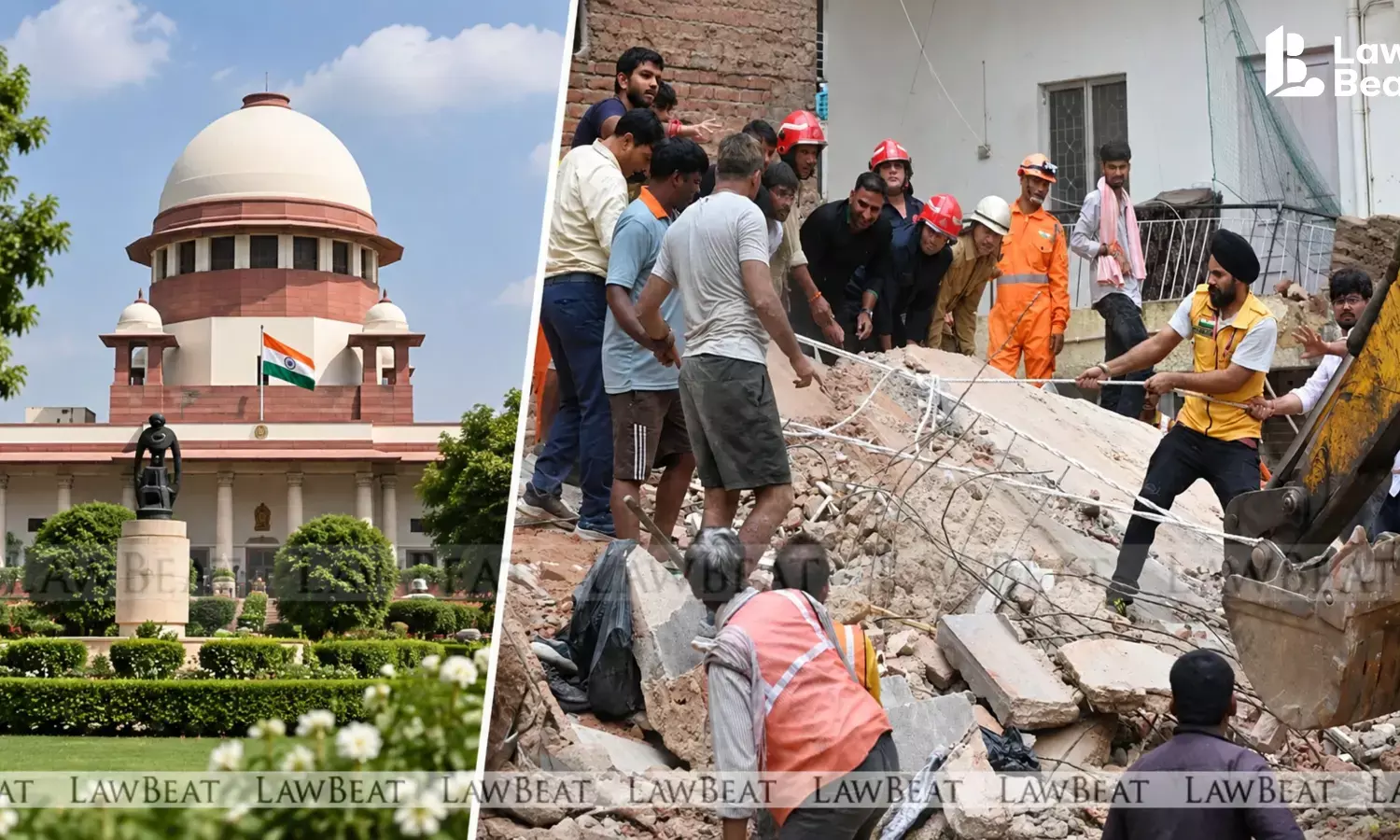
Supreme Court monitored action against illegal construction and residential-to-commercial misuse after the Satya Niketan building collapse
The Supreme Court on Thursday indicated that it will continue to monitor issues concerning illegal construction and non-conforming use of residential properties for commercial purposes in the wake of the Satya Niketan building collapse, which claimed seven lives and left 12 people injured.
The Bench of Justice Ahsanuddin Amanullah and Justice R. Mahadevan was hearing the matter concerning the ongoing action against illegal construction and unauthorised use of residential properties in Delhi and other areas.
At the outset, Amicus Curiae, Senior Advocate Ajit Kumar Sinha, flagged two core issues arising from the Court’s earlier directions: violations of building bye-laws and illegal construction, and the misuse of residential properties for commercial purposes.
Sinha submitted that the Supreme Court’s March 25, 2026 order was based on concerns that extended beyond the issue of paying guest (PG) accommodations. He urged the Court to ensure that its directions continued to cover other forms of unauthorised commercial use of residential premises, including gyms, coaching centres and BPOs.
The Amicus submitted that inspections had revealed several residential buildings being used for commercial activities, with some premises reportedly accommodating hundreds of people.
He further informed the Court that demolition of illegal structures had commenced in parts of Delhi and Lucknow, but stressed that the exercise required continued judicial monitoring.
“The issue is not restricted to PGs,” the Amicus submitted, pointing to the wider problem of illegal construction and commercial misuse of residential properties.
Supreme Court to initially focus on Non-conforming land use
Justice Amanullah said the Court would initially focus on the issue of non-conforming use of land, observing that it was a major area requiring attention.
The Court indicated that while other classifications and violations were equally important, limiting the initial exercise would ensure that the process moved faster and that the primary objective was not diluted.
Justice Amanullah particularly flagged residential areas and children’s play areas, observing that the situation was “completely in a mess”.
The Court indicated that such vulnerable areas would receive priority attention.
Solicitor General Tushar Mehta agreed that the government would also focus on non-conforming use, particularly in residential areas.
Mehta, however, requested that since the issue was essentially local in nature, the matter could be left to the Delhi High Court, which is already seized of the proceedings.
Justice Amanullah indicated that the exercise required greater control and coordination, with the initial focus remaining on non-conforming land use, residential areas and vulnerable locations such as schools.
The Judge stressed that following a structured procedure would make the exercise more effective and expedite the process.
At one point, Justice Amanullah told the Solicitor General: “Have faith in us, we know our objective. I think we are on the same track. Mr. Mehta, after two months you’ll understand what we are saying.”
Mehta responded: “Absolutely, we have full faith in your lordships.”
Amicus seeks continued monitoring of demolition, illegal construction
The Amicus urged the Supreme Court to ensure that authorities regularly report on the action taken against illegal construction and unauthorised commercial use. He submitted that although the Delhi High Court’s present exercise arose from the Satya Niketan tragedy and was primarily focused on PG hostels, the Supreme Court’s broader directions should continue to operate independently.
The Delhi High Court had directed the MCD to inspect PG hostels and ascertain whether the buildings were constructed in accordance with requisite permissions and whether there were violations of permissions or building bye-laws. Sinha argued that the exercise should not become confined only to PG accommodations because of the tragic incident. He also informed the Court that illegal structures, including constructions beyond the permitted fourth floor, were being demolished.
On the proceedings in Lucknow, the Amicus submitted that inspections had already been conducted with the assistance of his representatives and an IIT professor and that demolition had commenced.
The Delhi Government/MCD informed the Court that several steps had already been taken and that demolition had commenced in areas including Lajpat Nagar, Malviya Nagar and Sarojini Nagar. The authorities sought additional time to file their reports.
Supreme Court Declines to transfer Delhi HC proceedings
The Amicus opposed transferring the Delhi High Court proceedings to the Supreme Court, submitting that the High Court could continue with the exercise while the Supreme Court monitored compliance with its broader directions. He urged that authorities be directed to periodically file affidavits setting out the progress made, expressing concern that otherwise the exercise could once again stall.
The Supreme Court ultimately indicated that the proceedings need not be transferred from the Delhi High Court.
Instead, the authorities will continue the exercise before the High Court, while the Supreme Court may call for reports concerning the broader issues of illegal construction and non-conforming use of residential properties. The Court also noted that the Delhi High Court matter is coming up shortly and that its report would be available.
The matter will be heard next on September 15.
The Amicus report
In a report filed before the Supreme Court, Senior Advocate Ajit Kumar Sinha, assisting the Court as amicus curiae in the pending matter on illegal construction and unauthorised change of land use, flagged that Satya Niketan had not been covered under the Court's earlier inspection directions, which were confined to Lajpat Nagar, Saket and Malviya Nagar amid concerns over unsafe and unauthorised buildings.
The report notes that the September 6 collapse was not the locality's first: a building collapse in Satya Niketan in April 2022 had killed two persons and injured four others. "The recurrence of such an incident in the same locality raises serious concerns regarding the effectiveness of the existing mechanism for inspection, identification of dangerous structures, and enforcement of building bye-laws," the report states.
Sinha's report also points to construction-related activity reportedly underway in or around the basement of the collapsed structure, along with reports of water logging in the basement in the period immediately preceding the collapse; details that may bear on the eventual determination of what caused the building to come down.
What the Amicus has sought
The report seeks a time-bound inspection and safety audit of PG accommodations, private hostels and similar student-accommodation establishments in and around colleges and universities across Delhi, to be carried out by the court-appointed inspection committee.
The proposed audit would cover verification of sanctioned building plans against actual construction, the number of floors built, basement construction and any subsequent alterations, permitted land use, structural and fire safety, adequacy of ingress and egress, and identification of buildings in a dangerous or ruinous condition.
Background
Satya Niketan, located near Delhi University's South Campus, has over the years seen many of its small residential plots converted into PG accommodations and private hostels catering to students. Besides the 2022 collapse, the locality has recorded earlier building failures involving under-renovation structures.
The Satya Niketan tragedy also follows a similar collapse in May this year near Saidulajab in South Delhi, in which six people were killed; an incident in which, according to reports, police had flagged ongoing illegal construction to the Municipal Corporation of Delhi on two prior occasions without effective action being taken.
Separately, a PIL has also been filed before the Delhi High Court seeking an independent investigation into the Satya Niketan collapse, along with compensation for victims and a comprehensive structural safety audit of PGs and hostels across several student hubs in Delhi, including Vijay Nagar, Kamla Nagar, Mukherjee Nagar and Karol Bagh.
Notably, on September 7, a Delhi Court had remanded building owner Hariram Gupta and his wife Urmila Gupta to 14 days of judicial custody in connection with the Satya Niketan PG building collapse case, which claimed seven lives. Their son, Mahesh Gupta, was remanded to two days of police custody.
Case Title: Loganathan v. The State of Tamil Nadu and Ors.
Bench: Justices Ahsanuddin Amanullah and R. Mahadevan
Hearing Date: September 10, 2026